
A Security IT Audit is a structured assessment of an organisation's technical controls, configurations, and operational practices to identify security gaps, reduce risk, and validate that defences work as intended—not just on paper. It covers network infrastructure, endpoints, identity management, data handling, and security operations.
Most organisations discover their biggest vulnerabilities not during a breach, but during a properly scoped audit. The challenge is that many so-called audits stop at documentation review: they check whether a policy exists, not whether the control actually works under realistic attack conditions. That gap between policy and practice is where incidents happen.
A well-executed Security IT Audit closes that gap. It maps your asset landscape, tests controls against real attack paths, and produces prioritised findings that technical teams can act on and executives can understand. At Impulso Tecnológico, our approach is built on more than 26 years of IT services experience: we treat each audit as a defence-in-depth exercise, layering network, endpoint, identity, and resilience checks so that every finding connects to a concrete operational improvement—not just a compliance checkbox.
Security IT Audit in plain English: scope, goals, and what "IT" covers
A Security IT Audit is a systematic, evidence-based review of an organisation's IT environment to determine whether security controls are designed correctly, implemented consistently, and operating effectively. The "IT" in the name is deliberate: the scope extends beyond perimeter firewalls to include internal network architecture, endpoint configurations, identity and access management, data storage and transfer practices, logging and monitoring capabilities, and business continuity arrangements.
The primary goal is risk reduction, not regulatory box-ticking. Auditors examine whether controls would actually prevent or detect a realistic attack—not merely whether a policy document says they should. At Impulso Tecnológico, we frame this as a defence-in-depth assessment: each security layer is evaluated both independently and in relation to the layers around it, because a gap in one layer can undermine all the others.
| Dimension | Security IT Audit | Compliance Audit |
|---|---|---|
| Primary driver | Risk reduction and control effectiveness | Regulatory or contractual obligation |
| Scope definition | Defined by threat model and asset criticality | Defined by the applicable standard (e.g., ISO 27001, PCI DSS) |
| Testing depth | Includes active technical testing (scans, pentests) | Primarily documentation and process review |
| Output | Prioritised findings with exploitability context | Pass/fail against specific control requirements |
| Frequency | Risk-driven; typically annual or after major changes | Mandated by the standard or regulator |
| Audience | Security teams, IT operations, and executive leadership | Auditors, regulators, and board/legal teams |
What a Security IT Audit checks: controls, configurations, and real attack paths
A Security IT Audit focuses on security controls in practice, not only on documentation. Auditors verify that firewall rule sets actually block unauthorised traffic, that endpoint protection is active and updated on every device in scope, that privileged accounts require multi-factor authentication, and that backup jobs complete successfully and can be restored within acceptable timeframes. This distinction matters: a policy that mandates encryption is worthless if the configuration audit reveals that several file shares are still accessible over unencrypted protocols. Real attack paths—such as lateral movement from a compromised endpoint to a domain controller—are traced through configuration evidence, access logs, and, where appropriate, controlled penetration testing. The output is a map of exploitable gaps, not a checklist of documented intentions.
Security IT Audit vs compliance audit: when each is the right tool
The distinction is straightforward in practice: a compliance audit answers "do we meet the requirements of standard X?" while a Security IT Audit answers "are we actually secure?" The two overlap but serve different purposes. Compliance audits against frameworks such as ISO 27001, PCI DSS, or GDPR produce evidence for regulators, customers, or certification bodies. They are scoped by the standard, not by your threat landscape. A Security IT Audit is scoped by risk: which assets are most critical, which attack vectors are most plausible, and which controls are most likely to fail under pressure. Organisations that run only compliance audits often discover—too late—that passing an audit and being secure are not the same thing. The most effective programmes run both, using the Security IT Audit findings to strengthen the evidence base for compliance reviews.
Typical coverage areas: network, endpoints, IAM, logging, resilience, and third-party risk
A mature Security IT Audit covers six primary domains. Network security examines firewall configurations, segmentation, wireless access controls, and intrusion detection or prevention systems—technologies where partners such as Fortinet and Cisco provide the underlying controls that Impulso Tecnológico audits and implements. Endpoint security reviews antivirus coverage, patch status, personal firewall settings, and device encryption. Identity and access management (IAM) validates RBAC assignments, MFA enforcement, privileged account controls, and inactive account lifecycle. Logging and SIEM checks whether security events are captured, retained, and correlated in a way that supports incident detection. Resilience and disaster recovery tests whether backup jobs succeed, recovery time objectives are achievable, and DR plans have been exercised recently. Third-party risk assesses the security posture of suppliers and partners with access to your environment—an area that a risk-based security audit must not overlook.

Scoping and evidence collection: planning that prevents audit blind spots
Poor scoping is the most common reason a Security IT Audit produces findings that cannot be acted upon. When the boundaries are vague, auditors either over-test low-risk systems or miss critical assets entirely. At Impulso Tecnológico, our Computer Network Auditing service—offered as part of our managed IT support for clients in Madrid and beyond—begins with a structured scoping phase that maps both the physical and functional design of the corporate network before any testing starts. This includes structured cabling inspection, server room conditions (air conditioning, physical access controls), electricity installation, and a full inventory of connected devices. That physical-layer grounding prevents the most common audit blind spot: assuming that the logical network diagram reflects what is actually installed.
- Define objectives: Agree on what the audit must answer—risk reduction, pre-compliance readiness, post-incident review, or a combination.
- Set boundaries: Specify which systems, locations, and data flows are in scope, and document what is explicitly excluded.
- Identify stakeholders: Assign an audit owner, technical lead, and business sponsor; confirm who will receive findings and at what classification level.
- Map assets: Build or validate an asset inventory covering servers, endpoints, network devices, cloud workloads, and third-party connections.
- Surface shadow IT: Use network discovery scans and DHCP/DNS logs to identify devices and services not in the official inventory.
- Gather evidence: Collect network diagrams, firewall rule sets, access control matrices, backup logs, vulnerability scan reports, and prior incident records before testing begins.
- Confirm timelines and resources: Agree on testing windows that minimise operational disruption and allocate sufficient time for evidence review, not just active testing.
Scoping framework: objectives, timelines, roles, and what is explicitly out of scope
Start with objectives, boundaries, and stakeholder interviews to avoid scope drift. A scoping document should answer four questions before any technical work begins: What are we trying to learn? Which assets and systems are included? Who is authorised to conduct and receive the audit? What is the testing window and escalation path if a critical vulnerability is found during active testing? Defining what is out of scope is as important as defining what is in scope—undocumented exclusions lead to disputes about findings and gaps in remediation accountability. Timelines should account for evidence collection (often underestimated), active testing, analysis, and report drafting. Roles must be explicit: an audit without a named technical lead and a named business sponsor rarely produces findings that get acted upon within a meaningful timeframe.
Asset mapping and shadow IT: how to find what is connected but not documented
Building an asset inventory and mapping dependencies—including shadow IT—before testing begins is non-negotiable for a credible Security IT Audit. Shadow IT refers to devices, applications, and cloud services that employees use without formal IT approval or documentation: personal mobile devices connected to corporate Wi-Fi, unsanctioned SaaS tools storing business data, or a server installed by a department that was never registered in the CMDB. These assets are invisible to policy-based controls and frequently unpatched. Discovery techniques include passive network scanning (using tools such as Nmap), DHCP and DNS log analysis, cloud access security broker (CASB) data where available, and interviews with department heads. At Impulso Tecnológico, our network auditing process includes building a computer inventory as a standard deliverable, which ensures that subsequent testing covers the real environment rather than an idealised diagram.
Evidence pack checklist: policies, configurations, access logs, vulnerability scan outputs, and incident reports
Collecting evidence early—before active testing—ensures that findings can be validated against documented intentions and that gaps between policy and practice are clearly evidenced in the final report. A complete evidence pack for a Security IT Audit typically includes: network topology diagrams and firewall rule exports; server and endpoint configuration baselines; information security policies and acceptable use policies; access control matrices showing role assignments and privileged account lists; recent vulnerability scan outputs (from tools such as Nessus, Qualys, or OpenVAS); authentication and access logs covering at least the previous 90 days; backup job logs and the most recent disaster recovery test results; incident reports from the previous 12 months; and third-party supplier security questionnaires or contracts with security clauses. Gaps in this list are themselves findings: if backup logs do not exist, that is a control weakness, not a documentation oversight.
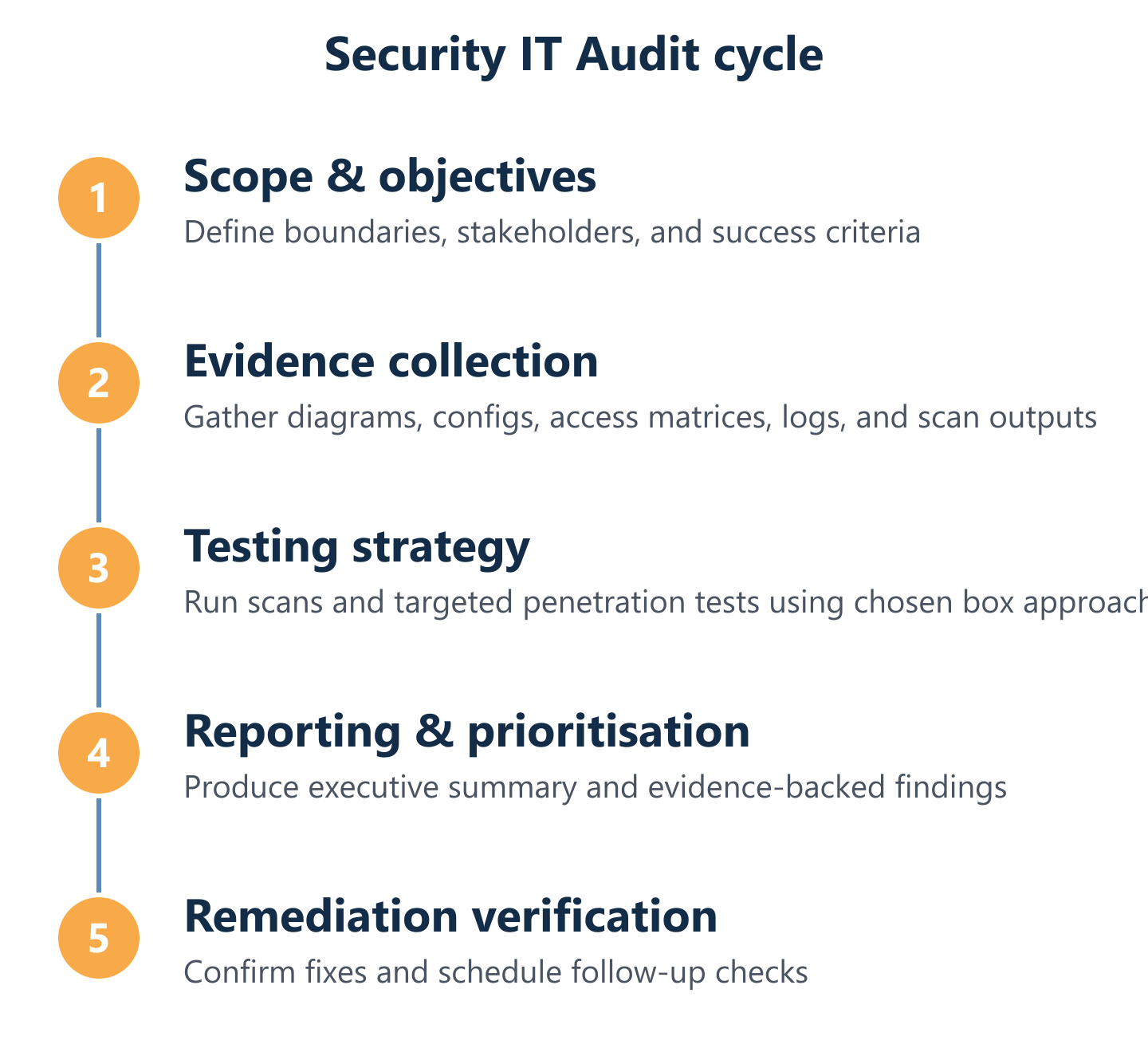
Testing strategy, reporting, and remediation: turning findings into risk reduction
The testing phase is where a Security IT Audit moves from evidence review to active validation. Two primary methods are used: vulnerability scanning and penetration testing. Scanning tools identify known weaknesses across a defined asset range quickly and at scale; penetration testing goes further by attempting to exploit those weaknesses to demonstrate real-world impact. Neither method alone is sufficient for a complete risk-based security audit—scanning without exploitation context underestimates risk, while penetration testing without prior scanning wastes time on easily detectable issues.
At Impulso Tecnológico, our layered checklist approach maps directly to testing outputs: we validate local network-based attack blocking (firewalls, intrusion detection, secure web content filtering, protected email), local PC-based controls (endpoint antivirus, personal firewalls, spyware elimination), and user security (secure passwords, VPN, remote access controls, file encryption, and identity management). Findings from each layer feed directly into a prioritised remediation plan, not a generic list of recommendations.
- Select the testing approach by risk profile: use vulnerability scanning for broad coverage across all in-scope assets; add penetration testing for high-criticality systems or where exploitability evidence is required for executive decision-making.
- Define the knowledge level: black-box testing simulates an external attacker with no prior knowledge; white-box provides full access to configurations and source; grey-box—the most common choice—balances realism with efficiency.
- Validate IAM controls actively: test RBAC assignments, MFA enforcement, and inactive account access rather than relying solely on configuration exports.
- Test logging and SIEM coverage: generate known-bad events and verify they are captured, alerted, and correlated correctly.
- Exercise disaster recovery: a DR plan that has not been tested is an assumption, not a control—resilience testing must be part of every cyber resilience audit.
- Structure the report for two audiences: an executive summary with business-risk framing, and a technical annex with evidence-backed findings, CVSS-style severity ratings, remediation steps, owners, and deadlines.
- Schedule follow-up audits: remediation verification and re-testing of failed controls should be built into the audit plan from the outset, not treated as optional extras.
Vulnerability scanning vs penetration testing: pros, cons, and when to use each
Choose testing types by risk profile: scanning for coverage, penetration testing for exploitability evidence. Vulnerability scanning uses automated tools to identify known weaknesses—missing patches, misconfigured services, default credentials—across a large number of assets in a short timeframe. It is repeatable, cost-effective, and suitable for regular baseline assessments. Its limitation is that it reports potential vulnerabilities without confirming whether they are actually exploitable in your specific environment. Penetration testing addresses that gap: a skilled tester attempts to chain vulnerabilities together to achieve a defined objective, such as accessing a sensitive database or escalating privileges to domain administrator. This produces high-confidence, business-contextualised findings. The practical recommendation for most organisations is to run automated vulnerability scans quarterly and commission a penetration test annually or after significant infrastructure changes—combining both methods within a single Security IT Audit cycle where budget and risk profile justify it.
Core control validation: IAM, RBAC/MFA, endpoints, logging, and disaster recovery checks
Validating core controls—IAM (RBAC/MFA), endpoints, logging and SIEM, and resilience and DR testing—is the technical heart of any Security IT Audit. For IAM, auditors review role assignments against the principle of least privilege, confirm MFA is enforced on all privileged and remote-access accounts, and check that inactive accounts are disabled within a defined SLA. RBAC validation involves comparing actual access rights against documented role definitions, looking specifically for privilege creep accumulated through role additions over time. Endpoint checks confirm that antivirus signatures are current, that patch levels meet policy, and that device encryption is active. Security logging and SIEM review verifies that log sources are complete, retention periods are met, and alert rules fire correctly against test events. Disaster recovery and resilience testing confirms that backups are restorable and that recovery time objectives are achievable under realistic conditions—not just theoretical ones documented in a plan that has never been exercised.
Reporting and remediation workflow: executive summary, evidence-backed findings, prioritisation, and follow-up audits
Report with actionable remediation steps, named owners, realistic timelines, and a planned re-audit cadence. A Security IT Audit report that produces no remediation action has failed its primary purpose. The report structure should include: an executive summary that frames findings in business-risk terms (potential operational impact, not just technical severity); a findings register with each issue evidenced by specific log entries, configuration extracts, or test outputs; a compliance gap mapping where relevant frameworks apply; a methodology and tools section for reproducibility; and a remediation plan with severity-ranked actions, assigned owners, and target completion dates. Severity should be assessed using a consistent model—CVSS scores provide a useful baseline, but business context (asset criticality, exploitability in your environment, regulatory exposure) must adjust the final priority. Follow-up audits to verify remediation should be scheduled before the primary report is issued, not as an afterthought once findings have been deprioritised by operational pressures.
A Security IT Audit delivers lasting value only when scope, evidence collection, testing, and remediation are treated as one connected workflow rather than four separate projects. Organisations that invest in planning the audit properly—mapping assets, defining boundaries, and selecting the right testing approach for their risk profile—consistently produce findings that are acted upon. Those that skip straight to scanning typically end up with a report that sits unread. Explore our computer network audit service or review our guidance on building a comprehensive IT security plan to understand how audit findings translate into lasting security improvements.