
Verkada in Madrid for businesses means designing, installing and supporting cameras, access control, environmental sensors and alarms that are all managed from Verkada Command, the vendor's cloud console. Cameras store footage on the device and are administered centrally over standard PoE networks, without a local NVR to maintain. That architecture simplifies daily operation, but it still requires decisions on coverage, bandwidth, roles, privacy, retention and who responds when an alert fires.
Impulso Tecnológico is a Verkada partner in Spain and Portugal. In Madrid, the site survey, installation and commissioning are carried out by our own team. This page explains how a Madrid project is scoped; for the full platform and the national service, see smart physical security with Verkada, and for companies with offices in both cities, compare it with our Verkada projects in Barcelona.
Verkada projects in Madrid with practical delivery
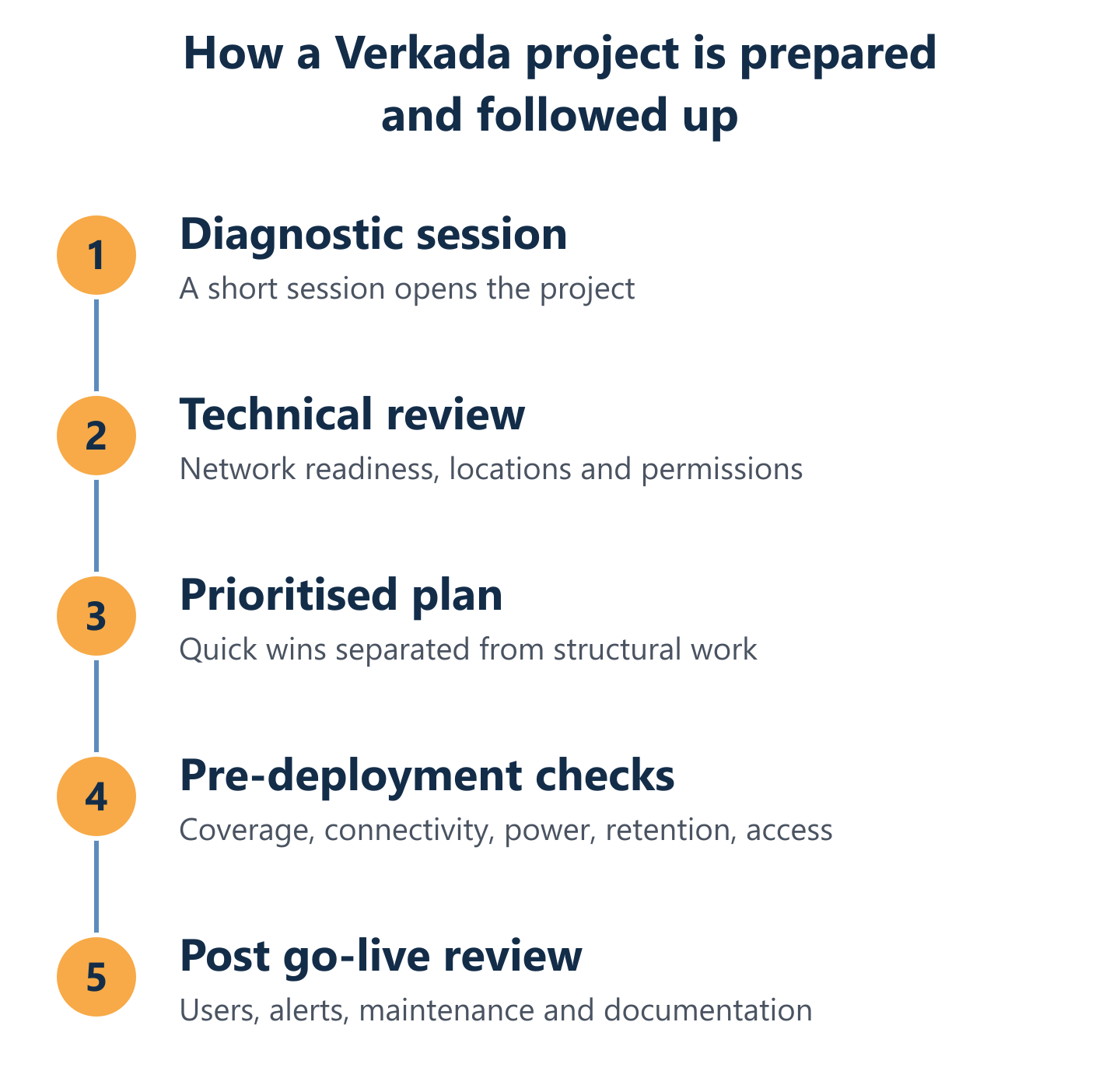
A Verkada project starts with a business conversation and a technical review. Protecting an office is not the same as protecting a warehouse, a retail chain with several stores or a building with access control. We identify critical areas, routes, entry points, video search needs, administrators and the procedure to follow when an alert fires. Then we document locations, angles, PoE power, connectivity, mounting, retention and access profiles, and check which existing infrastructure can be reused.
We help prepare cloud physical security projects by reviewing network readiness, locations, permissions, users and operating requirements. For door readers, credentials and commissioning, see what a professional access control installer should cover.
Assessment, priorities and roadmap
A well-chosen camera in the wrong place is still a poor investment. For each scene we review field of view, lighting, mounting height, indoor or outdoor conditions and what the image must show. On the network side we check PoE ports and power budget, uplink capacity, segmentation, internet access, cabling and monitoring, so the installation does not rest on assumptions.
When the project is part of a new office or a refit, we coordinate it with structured cabling and the network so every point is installed once, tested and documented.
Support, documentation and continuous improvement
Operational support matters after go-live. We help define ticket handling, escalation, preventive maintenance, monitoring, patching, access control and reporting, so the service remains useful when the first urgent request appears.
After go-live, users, alerts, maintenance, connectivity and documentation should be reviewed so the system remains reliable.

How we reduce risk before and after implementation
The common risk is buying a tool or a block of hours without deciding who owns outcomes. We reduce that risk by linking technical work to business continuity, security, user productivity and evidence that management can review.
Impulso Tecnológico is a Verkada partner in Spain and Portugal, listed on our partners page. Being a partner does not replace the survey: the proposal is a closed quote issued after the site study, with hardware, licences, installation, infrastructure work and maintenance shown separately.
What to review before choosing Verkada in Madrid
Before choosing a Verkada installer in Madrid, ask how the coverage study is done and what it delivers, who prepares the network and PoE, how licence terms are presented and who administers the platform once it is live. A proposal that only lists cameras and a unit price leaves the hard decisions for later.
Settle the usage policy early as well: who can watch live video, search recordings, export evidence, manage devices or receive alerts. We apply role-based permissions and keep a record of administrators, sites and groups. The company remains responsible for reviewing signage, purpose, retention and access to footage under data protection rules; we help organise the technical requirements and the operating documentation, without presenting the platform as automatic compliance.
Service quality indicators
A serious IT service should be measurable. Useful indicators include response time, resolution time, repeated incidents, backup status, pending patches, open risks, system availability and user satisfaction. Not every metric needs a complex report, but each one should support better decisions.
Documentation is another practical indicator. When a project leaves inventory, access records, procedures and next steps, the business gains continuity even if people or suppliers change later.
Recommended next steps
The usual first step is a short conversation to understand the context: company size, locations, critical services, urgent issues, current suppliers and business goals. From there, we can propose a technical review, a managed support model or a phased project with clear deliverables.
The priority is not to sell more technology. It is to decide what reduces risk, improves productivity and makes daily maintenance easier. That approach helps the company move with evidence instead of guessing.
Fit with the wider IT roadmap
This service should not be isolated from the wider IT roadmap. It normally connects with support maturity, cybersecurity posture, cloud adoption, network reliability, business continuity and user experience. When these areas are reviewed together, the company avoids solving one problem while creating another dependency elsewhere.
For that reason, Impulso Tecnologico documents assumptions, open risks and future decisions. The goal is to leave the business with a service that can be maintained, measured and improved over time, even when priorities change.
Maintenance after the first month
The first month should leave more than a closed ticket list. It should confirm priorities, recurring issues, pending risks and the next improvement cycle. This follow-up makes the service accountable and prevents early decisions from becoming hidden technical debt.