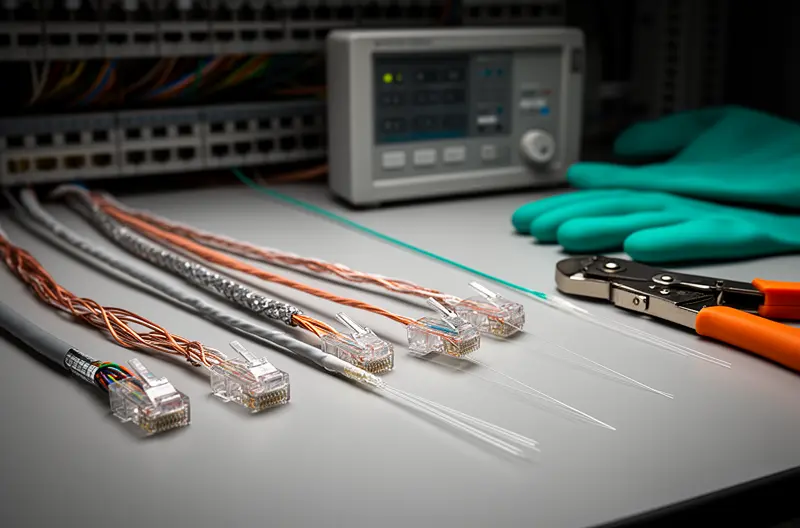
Structured cabling in Barcelona is the design and installation of a organised physical network — data outlets, patch panels, racks, copper and fibre runs — built to defined standards so that voice, data and Wi-Fi traffic run reliably across a building. It replaces ad-hoc wiring with a documented, testable system.
Many offices and industrial sites in Barcelona still run on cabling added in stages over the years, with no labelling, no test records and no clear rack layout. That makes every fault harder to trace and every office move or equipment upgrade slower and more expensive. A properly surveyed and certified installation solves this by mapping every outlet, testing every link and documenting the whole network. The result is a network infrastructure that supports current applications, professional Wi-Fi and security systems, while leaving clear capacity for future connections and higher-speed equipment.
Structured Cabling Barcelona: Scope and Business Value
A structured cabling installation covers the physical layer that every business application depends on: horizontal cabling to each workstation, vertical backbone runs between floors or buildings, patch panels, rack organisation and, increasingly, fibre optic links between distribution points. Done properly, it becomes the quiet infrastructure that professional Wi-Fi, VoIP, CCTV and cloud applications all rely on without anyone noticing — until it is missing.
Impulso Tecnológico brings more than 26 years of experience in IT infrastructure, and treats structured cabling as one part of a wider network environment rather than an isolated job. Our approach can connect cabling work with network electronics, segmentation, cybersecurity and ongoing monitoring, giving businesses in Barcelona a single point of accountability for the physical and logical network. Any specific equipment, cable category or certification scope is confirmed through a site assessment rather than assumed upfront.
| Approach | Documentation | Scalability | Fault-finding |
|---|---|---|---|
| Improvised/incremental cabling | None or partial | Limited, ad-hoc extensions | Slow, often invasive |
| Structured, certified cabling | Full test reports and labelling | Planned capacity for growth | Fast, isolated by outlet/rack |
| Cabling with integrated network design | Full documentation plus network diagrams | Aligned with Wi-Fi and segmentation plans | Fastest, supported by monitoring |
What Does Structured Cabling Include?
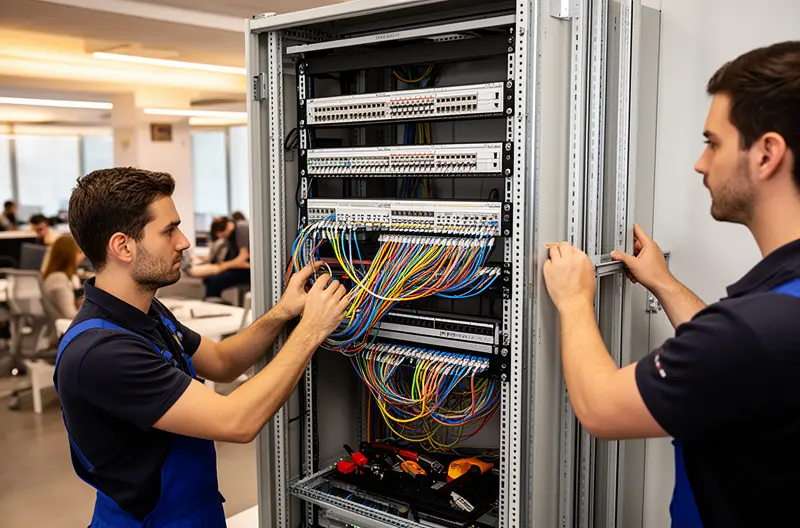
A complete structured cabling installation for offices in Barcelona typically covers certified network outlets at each workstation, patch panels in the communications rack, horizontal copper runs (usually Cat6 or Cat6A), and fibre optic backbone links where distances or bandwidth demand it. Rack organisation matters as much as the cabling itself: clean patching, dedicated pathways for power and data, and clear cable management reduce interference and make future changes far simpler. Every outlet and cable run should be labelled consistently and recorded in project documentation, so any technician — internal or external — can understand the network layout at a glance.
Benefits for Offices, Warehouses and Commercial Premises
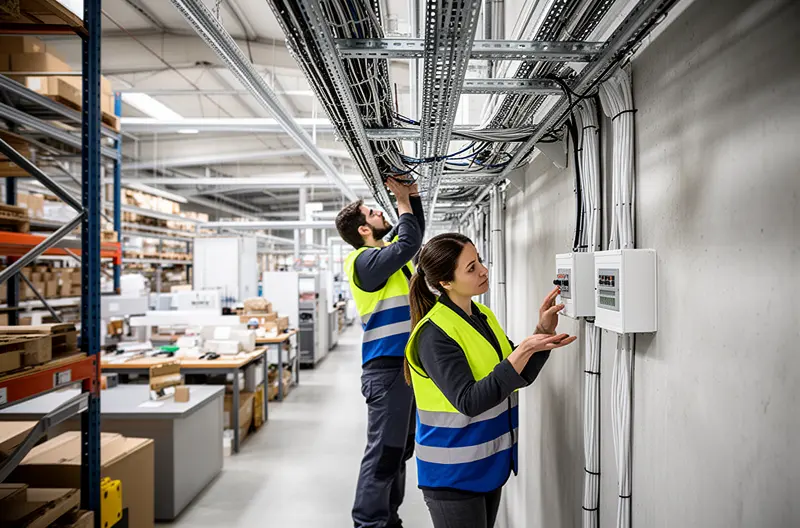
An organised network infrastructure directly supports the systems a business depends on daily: professional Wi-Fi coverage across open-plan offices, VoIP telephony, point-of-sale systems in retail premises, and connected scanners or sensors in warehouses and logistics sites. In commercial premises with high footfall, stable cabling reduces dropped connections during peak trading hours. In warehouses, structured cabling supports handheld devices, environmental sensors and security cameras across large floor areas. Because the infrastructure is documented, adding a new till, access point or workstation becomes a planned task rather than a disruptive one.
When Should a Business Upgrade Its Network Infrastructure?
Improvised cabling — extended informally over years, with no labelling or test records — tends to accumulate hidden risks: unidentified cables in the rack, outlets running below their rated speed, and faults that take hours to trace because no one knows which cable goes where. A documented, scalable installation removes that uncertainty. Signs it is time to upgrade include recurring unexplained network issues, office moves or expansions, plans to deploy professional Wi-Fi, or simply the absence of any certification records from the original installation. Waiting until a failure disrupts operations is usually more costly than planning the upgrade in advance.
Choosing the Right Cabling Solution for Your Site
Selecting between Cat6, Cat6A and fibre optic cabling is a commercial decision as much as a technical one, based on required speed, distance, the physical environment and budget. Impulso Tecnológico works through this decision systematically rather than defaulting to a single specification for every site.
- Assess current and expected users, applications and network load across the building.
- Review the existing infrastructure to identify limitations in cabling, rack space or wireless coverage.
- Define cable routes, distances and environmental conditions, including any industrial or outdoor sections.
- Recommend cabling categories and fibre requirements based on bandwidth needs and future growth.
- Confirm equipment choices and certification scope through an on-site assessment, coordinating where relevant with Cisco, Aruba or Fortinet network environments.
Cat6, Cat6A or Fibre Optic: Which Is Best?
Cat6 cabling supports Gigabit speeds over standard office distances and remains a solid choice for general workstation connectivity. Cat6A cabling installation in Barcelona offices is increasingly common where higher bandwidth, longer runs or future-proofing against 10 Gigabit equipment matter, particularly in server rooms and rack-to-rack backbones. Fibre optic network installation in Barcelona becomes the preferred option for longer distances, inter-building links, or environments with electrical interference, since fibre is immune to it and supports far greater bandwidth over extended runs than copper alternatives.
Copper Cabling, Shielding and Safety Specifications
Copper cabling comes in several formats — UTP (unshielded) and FTP or shielded variants — chosen according to interference risk and installation environment. Industrial sites with heavy machinery or dense electrical infrastructure often require shielded cabling to maintain signal integrity. Cable jacket specification also matters: LSZH (low smoke, zero halogen) cabling is standard for occupied buildings under fire safety considerations, and CPR classification determines which cable types are permitted for specific building types under EU construction product regulations. Maximum cable run distances between rack and outlet, typically around 90 metres for horizontal copper links, also shape how racks are positioned within a building.
Planning Connectivity for Growth and Future Upgrades
The right cabling category depends on the building, the equipment it will host, current applications and the traffic expected over the coming years — not on category specification alone. A retail premises with basic point-of-sale needs has different requirements from a logistics hub running scanners, sensors and multiple access points. Planning for growth means installing enough outlets, rack capacity and backbone bandwidth to absorb future demand without a full re-cabling project, and considering network rack organisation and cabling in Barcelona sites as part of one coherent design rather than a series of disconnected additions.
Professional Installation, Testing and Ongoing Support
A structured cabling project is only as good as its execution and its documentation. Impulso Tecnológico applies a practical, transparent methodology across every stage, treating cabling as part of a wider business network infrastructure rather than a standalone task.
- Clear consultation and site survey before any design decisions are made
- Rack organisation and cable routing planned around real building constraints
- Every outlet tested and certified, with full documentation handed to the client
- Flexible support models, with on-site assistance in Spain and remote coordination for international sites
- Structured cabling positioned within a broader managed services approach, covering monitoring, service-level agreements, firewall integration and continuity planning
Our Structured Cabling Installation Process
Our process begins with a requirements analysis covering users, applications and expected network load, followed by a detailed site survey to understand the building and existing infrastructure. From there we define cabling routes, rack layout and connectivity points, before installation begins with clean routing, patch panel termination and consistent labelling at every outlet. Once cabling is in place, we test each link, document the results and hand over a full set of project records, giving the client and any future technician a clear reference for the completed network.
Testing, Certification and Project Documentation
Certified network outlets in Barcelona installations are tested individually against category specifications, confirming that each link performs as expected before the network goes into service. Cable mapping records which outlet connects to which patch panel port, and test reports capture performance data for every run. Together, these documents mean that a fault months or years later can be isolated quickly, rather than requiring a technician to trace cabling physically through walls, ceilings or rack cabinets — saving time and reducing disruption during troubleshooting.
Maintenance, Troubleshooting and Network Evolution
Once installed, structured cabling still benefits from preventive maintenance: periodic rack inspections, documentation reviews and checks that labelling remains accurate as changes occur. Impulso Tecnológico coordinates on-site assistance across Spain through its Madrid team and the closest suitable local resource or available partner, confirming location, timing, scope and access per request, while providing remote coordination for international environments, supporting corrective maintenance when faults arise and helping plan network evolution as business needs change. Because the original installation is documented and certified, later work — adding outlets, extending fibre backbones or reorganising a rack — builds on reliable records rather than guesswork, reducing both cost and risk over the life of the network.
A network built on properly surveyed, installed, tested and documented cabling gives a business a dependable foundation for daily operations and for whatever comes next — new sites, more users, higher-bandwidth applications. The right design, cable category and certification scope for any given building depend on its specific requirements, which is why a site assessment remains the starting point for any serious structured cabling project in Barcelona.
For related context, review Assembly of Server Rooms and Communication Racks and Structured Cabling Services; these pages help connect this decision with adjacent IT priorities.