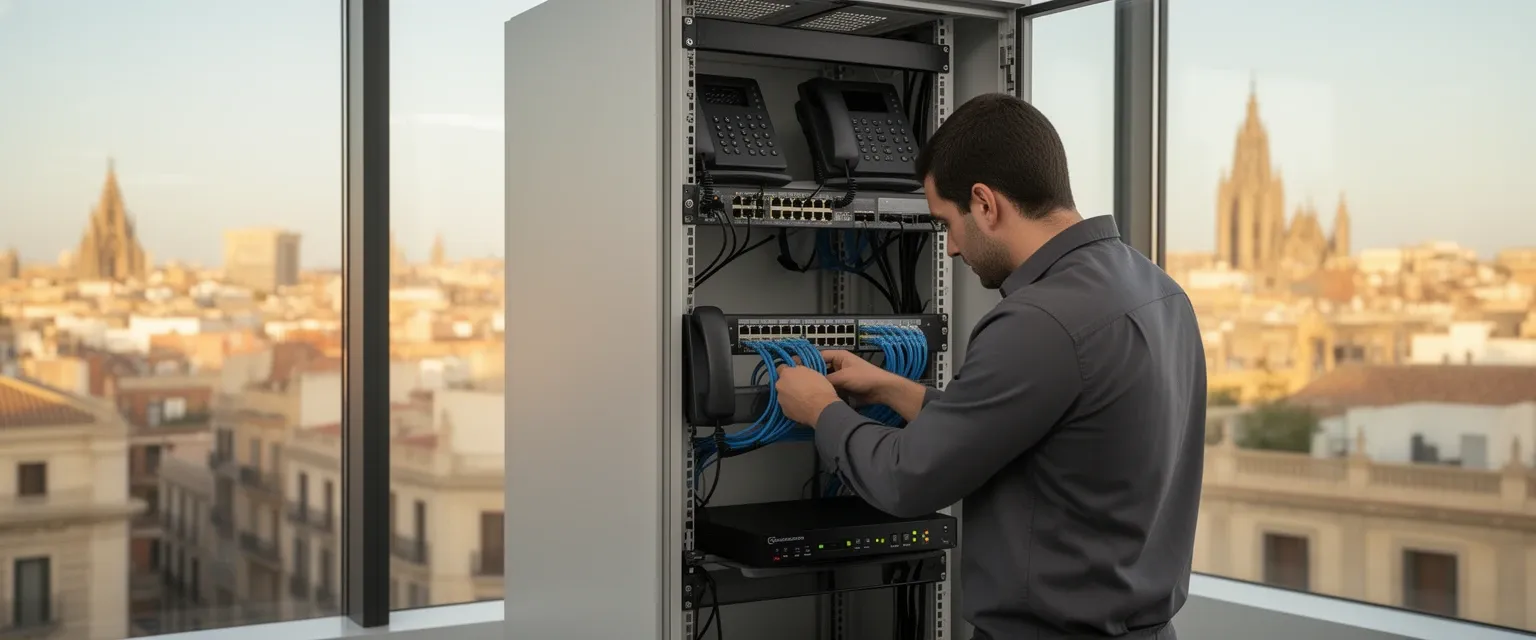
Business phone systems in Barcelona are telephone platforms—physical, IP, cloud-hosted or hybrid—that manage extensions, call routing, voicemail and external lines for a company. The right choice depends on call volume, number of users, existing infrastructure and whether staff work on-site, remotely or across multiple locations.
Many businesses in Barcelona are still running ageing analogue or digital systems that limit remote working, mobile extensions and integration with CRM or ticketing tools. Others have grown quickly and need a scalable cloud PBX without ripping out existing cabling. Impulso Tecnológico works through this problem with a technical diagnosis first: reviewing network readiness, connectivity and current terminals before recommending an architecture. The result is a business telephone system matched to real call flows rather than a generic package, with a migration path that avoids unnecessary downtime for teams that cannot afford interrupted communications.
Telephone PBX Systems in Barcelona: Choosing the Right Architecture
A business PBX manages how calls enter, move through and exit an organisation: extensions, ring groups, voicemail, external dialling rules and the caller's journey through an IVR. Physical, IP, cloud and hybrid architectures handle this differently, and the right fit depends on company size, call volume, existing infrastructure, remote working needs and growth plans rather than which system is newest.
Impulso Tecnológico approaches this as a consultative exercise. Before recommending a platform, our team reviews the organisation's network, cabling and connectivity, drawing on more than 26 years working with analogue and digital systems, IP and VoIP extensions, SIP trunking, and cloud-hosted and hybrid environments. This means a growing logistics firm and an established professional services practice can both be pointed towards a business telephone system that actually matches their operational reality, not a one-size-fits-all product.
| Criteria | Physical PBX | IP PBX | Cloud PBX | Hybrid |
|---|---|---|---|---|
| Upfront investment | Higher hardware cost | Moderate | Low, subscription-based | Moderate, phased |
| Remote working | Limited | Good | Excellent | Good |
| Multi-site support | Difficult | Good | Excellent | Good |
| Scalability | Limited | Good | Excellent | Good |
| Best for | Stable, single-site teams | Established businesses upgrading | Distributed or fast-growing teams | Businesses migrating gradually |
What Is a Business Telephone PBX?
In practical terms, a business PBX is the layer that decides what happens to every incoming and outgoing call. Extensions assign a direct internal number to each employee or department; ring groups let several extensions ring together so calls are answered faster; call routing directs callers to the right team based on time of day, department or IVR selection; voicemail captures messages when no one is available; and external line management controls how many simultaneous calls the business can make or receive, including SIP trunking capacity for VoIP-based systems.
Physical, IP, Cloud and Hybrid PBX Compared
Physical PBX systems, common with brands such as Alcatel and Panasonic, offer stability and full on-site control but limited flexibility for remote extensions. IP PBX systems route calls over the data network, supporting VoIP extensions and SIP trunking with better scalability. Cloud-hosted PBX removes on-site hardware almost entirely, making it well-suited to distributed teams and rapid scaling, though it depends on reliable internet connectivity. Hybrid setups combine an existing physical system with IP or cloud capabilities, useful when a full replacement isn't immediately practical.
Which Centralita Telefónica Suits Your Business?
A ten-person office with stable connectivity and no remote staff may be well served by an IP PBX built on existing cabling. A business with several Barcelona locations, remote employees or international teams typically benefits more from a cloud PBX with mobile extensions and centralised management. Companies with recent investment in physical handsets or existing digital systems often prefer a hybrid path, preserving working equipment while adding IP capabilities. Connectivity quality, headcount and multi-site operations should drive the recommendation, not the newest technology available.
Features, Installation and Migration for Barcelona Businesses
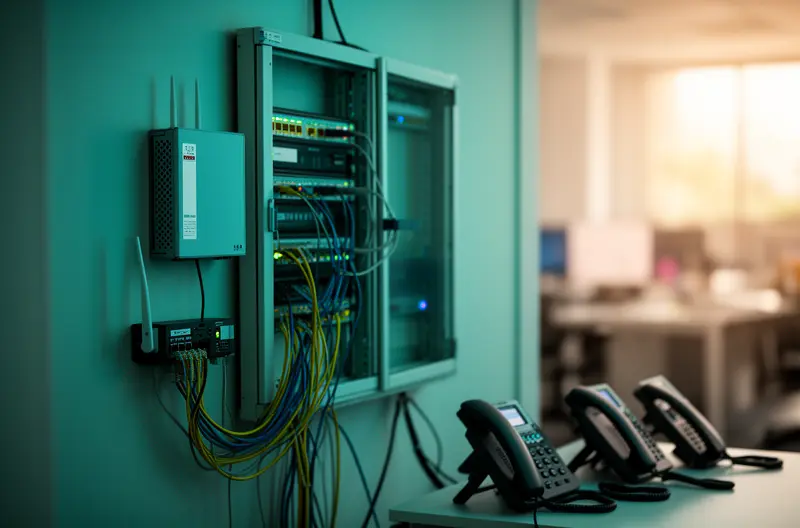
A telephone PBX installation is only as good as the process behind it. Skipping technical diagnosis or rushing activation tends to produce dropped calls, misrouted IVR paths or voice quality problems that surface only once the system is live. Impulso Tecnológico structures every Barcelona-based project—and every remote deployment for distributed teams—around the following phases:
- Assess existing cabling, switches, PoE availability, voice VLANs, internet connectivity, current telephone lines and terminals.
- Define the extension numbering plan, call groups, external dialling rules and opening-hours logic.
- Design the IVR journey and forwarding conditions based on how the business actually receives calls.
- Configure SIP trunking, provision IP phones and set up ring groups and voicemail.
- Integrate the PBX with CRM or ticketing platforms where required.
- Run acceptance testing across incoming and outgoing calls, transfers and voice quality.
- Deliver user training and documentation, then provide ongoing support.
Essential PBX Features for Efficient Business Calls
An IVR routes callers to the correct department without manual transfers. Call queues hold customers in order during busy periods rather than losing them to a busy signal. Forwarding rules send calls to mobile extensions when staff are away from their desk, which matters for hybrid and field-based teams. Voicemail-to-email keeps messages accessible without checking a desk phone. Call centre functions such as reporting and call recording support quality monitoring, while CRM or ticketing integrations let staff see caller history the moment a call connects.
Installation and Configuration Process in Barcelona
Every project begins with technical diagnosis rather than a standard product pitch: reviewing the network, current lines and terminals on site in Barcelona. From there, the numbering plan and call flows are designed around the business's actual working hours and departments. Configuration follows, covering terminals, SIP trunks and integrations, then acceptance testing confirms that incoming calls, transfers, forwarding and voicemail behave as expected. Documentation and user training close the process, giving staff and IT teams a clear reference for day-to-day operation and future changes.
Migrating Existing Numbers, Extensions and Equipment
Replacing a working telephone system carries real operational risk if done in one step. A gradual migration keeps the existing system operational while new IP extensions and VoIP capabilities are introduced in parallel, which suits businesses that cannot risk interrupted communications. SIP trunk configuration and IP phone provisioning are typically staged by department or site, allowing existing numbers and extensions to transfer without a hard cutover. This approach also gives staff time to adapt to new call flows before the legacy system is fully retired.

Maintenance, Security and PBX Costs in Barcelona
The initial installation is only part of the investment. Ongoing maintenance, security controls and support coverage determine whether a business telephone system keeps performing reliably years after activation, and these factors should shape any proposal a company evaluates. Impulso Tecnológico supports the wider IT environment that business telephony depends on, including managed services, network support and cybersecurity, with working knowledge of Alcatel, Panasonic, NEC, Siemens, Asterisk, Yealink and Grandstream platforms—selected according to each organisation's existing infrastructure rather than a fixed manufacturer preference. Businesses evaluating a PBX partner should look for the following:
- Preventive maintenance that catches ageing hardware issues before they cause outages
- Clear fault diagnosis procedures and access to spare parts for established manufacturers
- SIP authentication and restrictions on unauthorised international calling
- GDPR-aligned handling of call recordings, including secure storage and retention limits
- Transparent cost factors covering extensions, terminals, connectivity and integration complexity
- Support that covers both on-site Barcelona visits and remote assistance for distributed teams
Repair and Ongoing Maintenance for Telephone PBX Systems
PBX repair and maintenance in Barcelona typically starts with fault diagnosis: identifying whether an issue sits in the hardware, the network or the configuration. Ageing analogue and digital systems, including established Alcatel and Panasonic installations, often need spare parts that become harder to source over time, making preventive checks more valuable than reactive fixes. Regular maintenance covers firmware updates, voice quality checks and capacity reviews as call volumes grow, reducing the likelihood of a full system failure during business hours.
What Influences Centralita Telefónica Installation Costs?
Pricing depends on the architecture chosen—physical, IP, cloud or hybrid—along with the number of extensions and terminals required. Connectivity readiness matters too: a site needing new structured cabling or PoE switches costs more to prepare than one with existing infrastructure. Integrations with CRM or ticketing platforms add configuration time, as does migration complexity when numbers and extensions must transfer from a legacy system without disruption. Ongoing support coverage, whether limited to remote assistance or including scheduled on-site visits in Barcelona, is a separate but significant factor. A tailored assessment remains the only reliable way to price a specific project.
Security and Compliance for Business Telephony
VoIP and SIP-based systems introduce security considerations that traditional analogue lines didn't face. Strong SIP authentication prevents unauthorised registration on the trunk, while restrictions on international dialling limit exposure to toll fraud. Where calls are recorded for training or compliance purposes, storage needs to be secured and access controlled, with retention periods aligned to GDPR requirements. These controls should be reviewed as part of any installation or migration project, not added as an afterthought once the system is already live.
Choosing between physical, IP, cloud and hybrid phone systems comes down to how your business actually communicates: call volume, remote working patterns, existing infrastructure and where growth is heading over the next few years. A technical assessment is the most reliable way to clarify whether a new installation, an upgrade or a phased hybrid migration makes sense for your Barcelona operation. Related reading on telephone switchboard installation for businesses and business telephone switchboards for companies covers implementation detail further, while our guide to maintenance of telephone switchboards addresses long-term support planning.
For related context, review Telephone switchboard installation for businesses and Business telephone switchboards for companies; these pages help connect this decision with adjacent IT priorities.