
IT solutions for businesses are the combination of infrastructure, security, cloud services, and managed support that keep an organisation running reliably, securely, and at a predictable cost. They range from basic help-desk support to fully outsourced IT management, and the right mix depends on your size, risk profile, and compliance obligations.
Most businesses reach a point where reactive IT — fixing problems after they occur — becomes genuinely expensive. Unplanned downtime disrupts operations, security incidents erode trust, and the hidden cost of managing multiple vendors adds up quickly. The shift to a structured IT solutions model addresses all three: it replaces unpredictable break-fix spending with proactive monitoring and maintenance, consolidates vendors under a single accountable provider, and aligns technology decisions with business goals rather than IT convenience. Organisations that make this shift typically see fewer incidents, faster resolution times, and clearer control over their technology budget — outcomes that translate directly into operational stability and competitive resilience.
New platforms still need a controlled production handover. Our business server installation service connects planning, hardening, backup readiness and acceptance testing with the wider managed IT operating model.
What IT solutions for businesses include (and who they suit)
The term "IT solutions for businesses" covers a broad spectrum, but in practice it refers to the technology services and management capabilities an organisation needs to operate without disruption. That means keeping devices, networks, and data secure; ensuring systems are available when staff need them; and having a clear escalation path when something goes wrong. For most organisations, this is not a single product — it is a layered model of infrastructure, security, cloud, and operational support working together.
At Impulso Tecnológico, we approach IT as an enabler of business operations rather than a source of complexity. With over 26 years of experience as a Managed Services Provider, we work with organisations across Spain, Portugal, and internationally to design IT environments that perform reliably and scale with the business. Our model combines proactive monitoring and preventive maintenance with on-site and remote support, so problems are identified and resolved before they affect operations.
| IT Solution Category | What It Covers | Best Suited For | Without It: Key Risk |
|---|---|---|---|
| Managed IT Services | Monitoring, patching, help desk, device management | SMEs without internal IT teams | Unplanned downtime, slow incident resolution |
| Cybersecurity | Endpoint protection, firewall, access control, backup | All sizes, especially regulated sectors | Data breaches, ransomware, compliance failure |
| Cloud Solutions | Microsoft 365, Azure, cloud backup, identity management | Distributed teams, remote-work environments | Data loss, collaboration bottlenecks |
| IT Infrastructure | Network design, cabling, Wi-Fi, fibre optic | Multi-site operations, new office builds | Connectivity failures, poor performance |
| IT Outsourcing | Full or partial IT department management | Businesses scaling without adding headcount | High internal IT cost, skill gaps |
The business outcomes behind IT solutions (uptime, productivity, risk reduction)
IT solutions combine infrastructure, security, and day-to-day operations under one accountable model — and the measurable outcomes are what justify the investment. Uptime is the most immediate: every hour of unplanned downtime carries a direct cost in lost productivity, missed transactions, and staff time spent on workarounds. Beyond availability, a well-structured IT environment reduces the number of incidents that reach end users in the first place, which has a compounding effect on productivity. Risk reduction is the third pillar: organisations with proactive IT monitoring and layered security are significantly less exposed to ransomware, data loss, and the reputational damage that follows a breach. These outcomes are not abstract — they show up in ticket volumes, resolution times, and the frequency of business-impacting incidents.
Core categories: security, infrastructure, cloud, and IT operations
Managed IT services typically cover four interconnected areas. Security encompasses endpoint protection, firewall management, access control, and backup — technologies where Impulso Tecnológico works with Sophos, Fortinet, and Veeam to deliver layered defence. Infrastructure covers the physical and logical foundations: network cabling, Wi-Fi design (Cisco, Aruba), fibre optic installations, and environmental monitoring. Cloud services — primarily Microsoft 365 and Azure — handle collaboration, identity, and data resilience. IT operations tie everything together: proactive monitoring, patch management, help-desk support, and incident response. When these four categories are managed by a single provider under defined service agreements, the result is a coherent IT environment rather than a patchwork of disconnected tools and vendors.
Common starting points: small teams, multi-site operations, and regulated environments
The right entry point into managed IT depends on where an organisation currently sits on the maturity curve. Small teams with no dedicated IT staff typically start with device management and help-desk support — moving from reactive break-fix to a fixed monthly cost per device that covers unlimited assistance. Multi-site operations have different priorities: consistent network performance across locations, centralised monitoring, and standardised security controls. Regulated environments — healthcare, finance, education — add a compliance layer: documented controls, access management, and audit-ready evidence. Impulso Tecnológico's experience across these three profiles, serving over 470 organisations across sectors including industry, logistics, and professional services, means the onboarding process is calibrated to the organisation's actual starting point rather than a generic template.

How to choose the right IT solutions: criteria and trade-offs
Selecting an IT solutions provider is a procurement decision with long-term operational consequences. Price is rarely the right primary filter — the more useful criteria are service scope, security depth, compliance readiness, and the provider's ability to demonstrate consistent delivery. Impulso Tecnológico centralises IT services under one provider to reduce cost and complexity, working with recognised technology partners including Microsoft, Cisco, Aruba, Fortinet, Veeam, and Sophos to deliver consistent outcomes across security, infrastructure, and cloud.
- Define your non-negotiables first. Identify which services are critical to operations — monitoring, backup, endpoint security — and confirm these are included in the base contract, not sold as add-ons.
- Scrutinise the SLA structure. Look beyond headline response times: what are the resolution targets? What escalation paths exist? What happens outside standard service hours?
- Assess security coverage end-to-end. A provider should be able to describe how they protect endpoints, manage network access, handle patch cycles, and respond to a ransomware event — not just list the tools they use.
- Check compliance alignment. If your sector has regulatory obligations (GDPR, industry-specific frameworks), the provider should map their controls to those requirements and provide evidence on request.
- Evaluate flexibility and contract terms. Rigid, long-term contracts with no adjustment mechanism are a risk when your business changes. Providers who adapt to real requirements — as Impulso Tecnológico does — reduce lock-in and align better with growth.
- Ask for references and measurable outcomes. Ticket resolution rates, client retention, and satisfaction data are more useful than marketing claims. Impulso Tecnológico resolves over 4,000 IT tickets annually across its active client base.
Service scope and SLAs: monitoring, patching, help desk, and incident handling
IT support SLAs are only as useful as the clarity behind them. Before signing with any provider, ask for a written breakdown of what is monitored, how frequently patches are applied, who handles incidents at each severity level, and what the escalation path looks like when a critical system fails. Response time and resolution time are different metrics — a provider might respond within one hour but take two days to resolve a server failure. Equally important is understanding what is explicitly excluded: some contracts cover software support but not hardware replacement, or remote support but not on-site visits. Impulso Tecnológico's managed services model includes both remote and on-site technical assistance under a fixed monthly fee, which removes the ambiguity around what is covered and eliminates unexpected charges when incidents require physical intervention.
Security and continuity: backup, disaster recovery readiness, and ransomware prevention
Cybersecurity for SMEs is not a single product — it is a layered set of controls that must cover endpoints, network perimeters, user access, and data recovery. Ransomware prevention, for example, requires endpoint protection (Sophos or Fortinet agents), network segmentation, email filtering, and a tested backup strategy — because any one of these failing alone can result in a successful attack. Backup is not the same as disaster recovery: backup stores data, but disaster recovery defines how quickly systems can be restored and operations resumed after an incident. Impulso Tecnológico delivers cloud-based data backup with automatic, reliable protection, combined with network security and access control systems. For organisations that need to demonstrate continuity planning — whether for insurers, auditors, or clients — having documented recovery procedures and tested restore processes is increasingly a commercial requirement, not just a technical best practice.
Compliance support without jargon: mapping requirements to controls and evidence
Compliance readiness is most useful when it is framed as a business case rather than a regulatory checklist. Start by identifying which frameworks apply to your organisation — GDPR applies to virtually all businesses handling personal data in the EU; sector-specific requirements such as PCI-DSS (payments), HIPAA (healthcare data), or ISO 27001 may apply depending on your industry and client contracts. Once the applicable requirements are clear, map them to the controls your IT provider already delivers: access management, encryption, audit logging, patch management, and incident response documentation. The gap between what you have and what you need is your compliance roadmap. Impulso Tecnológico supports GDPR compliance as a baseline across all managed environments, and can align security controls to additional frameworks where required. Documenting this alignment also has a direct commercial benefit: many enterprise clients and insurers now require evidence of IT security controls before awarding contracts or issuing cyber insurance policies.
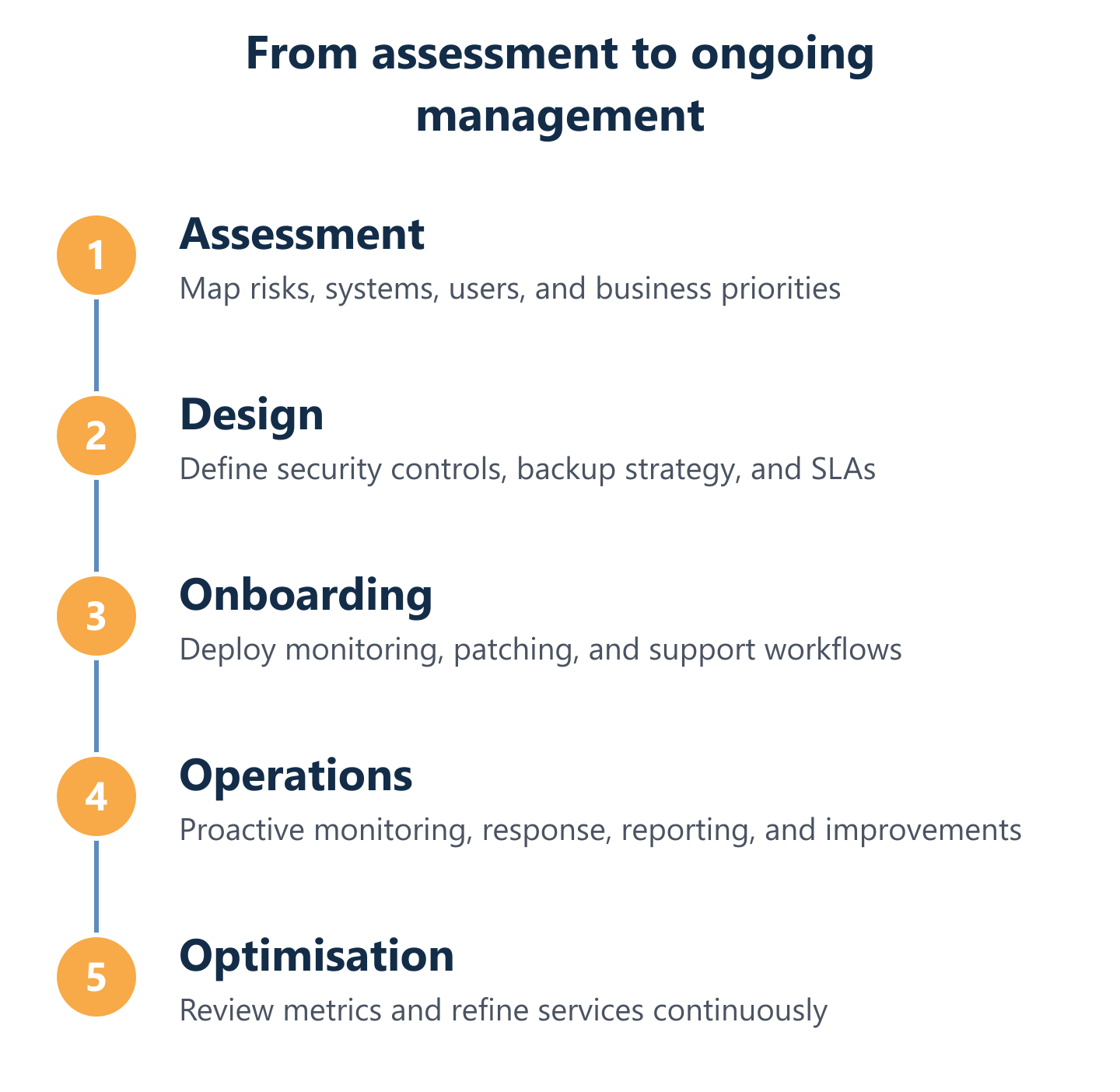
Implementation roadmap: from assessment to ongoing management
Moving from an ad hoc IT environment to a structured managed services model follows a predictable sequence — and understanding that sequence helps set realistic expectations for both the organisation and the provider.
- Assessment first, solutions second. No implementation should begin without a documented picture of the current environment — devices, network topology, security gaps, and existing contracts.
- Design aligned to business goals. The solution architecture should reflect operational priorities: which systems are business-critical, what the recovery time objectives are, and where compliance requirements apply.
- Phased onboarding reduces disruption. Deploying monitoring, endpoint agents, and backup in stages — rather than all at once — allows the team to stabilise each layer before moving to the next.
- Automation improves consistency. Impulso Tecnológico integrates workflow automation tools such as n8n, Make.com, and Odoo to reduce manual tasks and improve the reliability of routine IT processes.
- Continuous improvement is built in. Ongoing managed services should include regular reporting, periodic reviews, and proactive recommendations — not just reactive ticket handling.
Assessment and design: what to document before implementation
A structured IT assessment is the foundation of any successful implementation. Before deploying new tools or migrating services, document the current state across four areas: devices (inventory, operating system versions, patch status), network (topology, switch and firewall configurations, Wi-Fi coverage), cloud (active subscriptions, identity management, backup coverage), and security (existing controls, known vulnerabilities, access policies). This baseline serves two purposes: it identifies the risks and gaps that need addressing immediately, and it establishes the quick wins — low-effort, high-impact changes — that build confidence in the new provider relationship. For organisations considering IT outsourcing, the assessment also determines the scope of the managed services contract, ensuring that pricing reflects actual complexity rather than assumptions. Skipping this step is the most common reason IT transitions fail in the first 90 days.
Onboarding and first 30–60 days: stabilise, measure, and reduce friction
The first 30–60 days of a managed IT engagement are about stabilisation, not transformation. The priority is establishing clear ownership: who has administrative access to which systems, how tickets are raised and routed, what the baseline monitoring alerts look like, and where the documentation lives. During this period, the provider should deploy monitoring agents across all in-scope devices, confirm backup jobs are running and tested, and resolve any critical vulnerabilities identified in the assessment. Staff communication matters here — users need to know how to contact the help desk, what response times to expect, and who their primary point of contact is. Impulso Tecnológico's onboarding process is designed to reduce friction from day one, with both remote and on-site support available to address issues as they surface during the transition period.
Ongoing management: proactive monitoring, maintenance, and service reporting
Proactive IT monitoring is what separates managed services from glorified break-fix support. Once the environment is stable, the focus shifts to continuous improvement: scheduled patch cycles, regular vulnerability scans, capacity planning, and periodic reviews that connect IT performance to business outcomes. Service reporting should translate technical metrics — ticket volumes, resolution times, system availability — into language that non-technical stakeholders can act on. Quarterly reviews are the right cadence for most organisations, covering what has been resolved, what is planned, and whether the current service scope still matches business needs. Impulso Tecnológico's proactive model is built around preventing incidents before they reach end users, which is why clients across Spain, Portugal, and internationally report that responsiveness and personalised service are the qualities they value most in the relationship. For further detail on how this translates into specific service lines, our IT services for businesses page covers the full scope of what is included.
Choosing IT solutions for businesses is ultimately a decision about operational resilience: how quickly can your organisation recover from an incident, how predictably can you control technology costs, and how confidently can you meet the security and compliance expectations of your clients and regulators? The answer starts with mapping your current environment to your actual requirements — not a generic service catalogue — and selecting a provider that can demonstrate, not just describe, how it will deliver results day to day. If you are evaluating options, our IT consulting services in Spain and Portugal overview and our IT consulting Madrid page are useful starting points for understanding how Impulso Tecnológico structures its engagements.