
IT company in Madrid helps companies turn recurring IT friction into a managed operating model: clear scope, implementation plan, support responsibilities, security checks and measurable follow-up. Impulso Tecnologico works with business teams that need practical help, not another abstract report, so the engagement starts with priorities and ends with an actionable roadmap.
This page is written for organisations comparing suppliers, preparing a migration, opening a new office or trying to stabilise support after repeated incidents. The aim is to clarify what the service includes, how it is delivered and which decisions should be made before committing budget.
For related service scope, explore Managed IT helpdesk for businesses and EDR and MDR for businesses.
IT company in Madrid with practical delivery
The scope normally combines discovery, technical assessment, implementation, documentation and ongoing support. Depending on the environment, we review users, locations, devices, cloud services, network dependencies, security controls, backups, telephony, vendors and internal ownership.
We act as an external IT provider for support, maintenance, cloud, cybersecurity, networks, backups and improvement projects.
Assessment, priorities and roadmap
A controlled project starts with a short diagnostic session, then a technical review and a prioritised plan. We separate quick wins from structural work, define responsibilities, agree service levels and document the setup so future changes do not depend on memory or improvisation.
The first step identifies recurring incidents, technical risks, critical suppliers and priorities to stabilise operations.
Support, documentation and continuous improvement
Operational support matters after go-live. We help define ticket handling, escalation, preventive maintenance, monitoring, patching, access control and reporting, so the service remains useful when the first urgent request appears.
The service can include helpdesk, preventive maintenance, planned onsite visits, remote support, reporting and management coordination.

How we reduce risk before and after implementation
The common risk is buying a tool or a block of hours without deciding who owns outcomes. We reduce that risk by linking technical work to business continuity, security, user productivity and evidence that management can review.
Changing provider without diagnosis often moves the same problems to a new inbox. We define scope and responsibilities before promising outcomes.
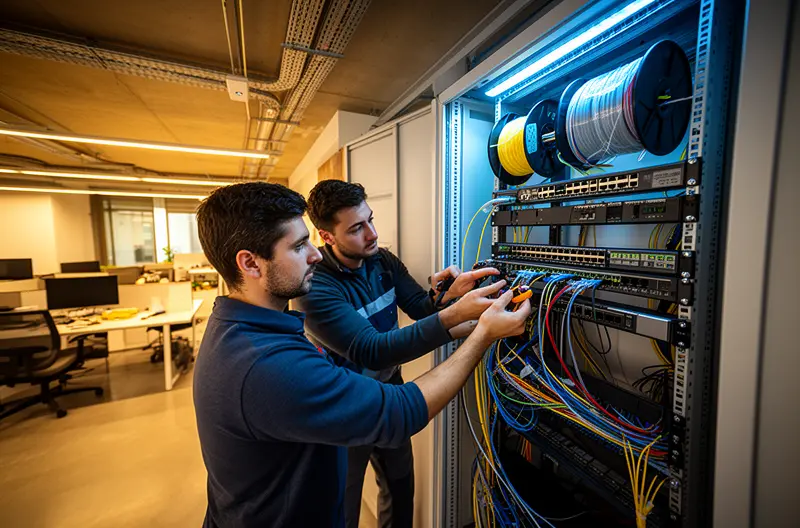
What to review before choosing it company in madrid for businesses
Before choosing a supplier, clarify the problem you want to solve, which systems are critical and how much support the business needs after the first intervention. This prevents incomplete quotes and separates urgent fixes from structural improvements.
We also recommend reviewing users, locations, permissions, current suppliers, tools, backups, access security and existing documentation. If an internal IT team is already in place, the service can complement it with specialist tasks, escalation or preventive review.
Service quality indicators
A serious IT service should be measurable. Useful indicators include response time, resolution time, repeated incidents, backup status, pending patches, open risks, system availability and user satisfaction. Not every metric needs a complex report, but each one should support better decisions.
Documentation is another practical indicator. When a project leaves inventory, access records, procedures and next steps, the business gains continuity even if people or suppliers change later.

Recommended next steps
The usual first step is a short conversation to understand the context: company size, locations, critical services, urgent issues, current suppliers and business goals. From there, we can propose a technical review, a managed support model or a phased project with clear deliverables.
The priority is not to sell more technology. It is to decide what reduces risk, improves productivity and makes daily maintenance easier. That approach helps the company move with evidence instead of guessing.
Fit with the wider IT roadmap
This service should not be isolated from the wider IT roadmap. It normally connects with support maturity, cybersecurity posture, cloud adoption, network reliability, business continuity and user experience. When these areas are reviewed together, the company avoids solving one problem while creating another dependency elsewhere.
For that reason, Impulso Tecnologico documents assumptions, open risks and future decisions. The goal is to leave the business with a service that can be maintained, measured and improved over time, even when priorities change.
Maintenance after the first month
The first month should leave more than a closed ticket list. It should confirm priorities, recurring issues, pending risks and the next improvement cycle. This follow-up makes the service accountable and prevents early decisions from becoming hidden technical debt.
Services a Madrid IT company should cover
An IT company in Madrid should not only close isolated tickets. For a business with office users, cloud services, suppliers and management expectations, the value is in connecting daily support, preventive maintenance, cybersecurity, continuity, cloud, networks and vendor coordination. That joined-up view prevents each issue from becoming a separate purchase or a recurring emergency.
At Impulso Tecnologico we review the full environment before recommending changes: workstations, servers, Microsoft 365, backups, firewalls, remote access, telephony, connectivity, critical software and technical documentation. With that baseline, the company can decide what to keep, what to fix first and what should be planned in phases.
The service can work as the main outsourced IT provider or as specialist support for an internal team. In both cases, management should gain visibility over risks, priorities, recurring costs and pending improvements, not just a list of closed support tickets.
Onboarding and transition from another provider
When a business changes IT provider, the biggest risk is often the transition itself: incomplete passwords, scattered documentation, untested backups, licences with no owner and external suppliers nobody coordinates. We start with an organised handover, technical inventory and access review.
The transition includes validating backups, reviewing administrator accounts, confirming renewals, identifying unsupported devices and documenting dependencies between systems. If incidents are already open, we classify them by impact so the business knows what must be solved immediately and what can move into a monthly plan.
SLA, support and preventive maintenance
Business IT support works better when expectations are explicit. We agree intake channels, support hours, priorities, response targets, escalation owners and criteria for onsite intervention. This avoids confusion during incidents and makes the service measurable.
Beyond reactive support, we recommend a preventive calendar: patch status, backup health, security alerts, storage capacity, inactive users, certificate expiry, network health and devices at risk of failure. Prevention reduces disruption and turns IT into a managed business function.
Security, backup and continuity inside the service
Security cannot sit outside maintenance. A responsible IT company should check MFA, permissions, antivirus or EDR, firewall rules, VPN, email security, backups and recovery. The question is not only whether a backup exists, but whether it can be restored within the time the business can tolerate.
We also review common risks in Madrid-based companies: excessive permissions, unmanaged laptops, old accounts, shared access, unsegmented WiFi, weak supplier credentials and cloud services nobody audits. Fixing these points often creates more value than adding another tool without governance.
The output should be a realistic continuity plan: which systems are critical, how long each area can be unavailable, who decides during an incident and which evidence is reviewed every month.
When to request a proposal from Impulso Tecnologico
It makes sense to request a proposal when incidents repeat, the user base is growing, an office move is planned, security is unclear, cloud migration is pending, documentation is missing or the current provider only reacts when something breaks. In that situation, an initial review separates symptoms from causes.
The conversation does not need to start with a long contract. We can review the environment, identify risks, prioritise actions and define whether the right next step is recurring managed support, a focused intervention or a phased project. The important point is that the decision is based on technical evidence and a clear view of the business.
Signals that the service is working
An IT company should be able to show progress through simple indicators: fewer recurring incidents, shorter resolution times, verified backups, correct user access, controlled renewals and updated documentation. If the provider cannot explain what has changed in the environment, the service becomes hard to govern.
That is why we recommend periodic reviews with operational data, open risks and next actions. The goal is not to produce reports for their own sake, but to help management decide clearly: what has been stabilised, what needs investment and what can wait.
Recommended first steps
The recommended next step is a short review with three outputs: risk map, support proposal and improvement priorities. From there, the business can decide whether to start by stabilising incidents, organising security, reviewing backups, migrating services or taking on full IT maintenance. The proposal should make scope, owners, costs, milestones, review cadence, accountability and review date clear.