
Cybersecurity services in Madrid cover a broad spectrum—from SOC-as-a-Service and managed detection and response to GDPR compliance support and penetration testing. Madrid-based organisations can access enterprise-grade security controls, proactive monitoring, and incident response capabilities from providers with local delivery and clear SLA commitments.
The challenge most organisations face is not a shortage of providers—it is knowing which service model fits their actual risk exposure, infrastructure complexity, and operational budget. A company running Microsoft 365 and Azure workloads has different monitoring requirements than a manufacturer with on-premise systems and legacy endpoints. When security is treated as a standalone purchase rather than an integrated part of IT operations, gaps appear: backups are not tested, endpoints fall behind on patches, and incident response plans exist only on paper.
The practical solution is to align security services with operational continuity from the outset. At Impulso Tecnológico, we combine multi-layer security controls with proactive monitoring and managed IT operations—so protection is built into the infrastructure, not bolted on after an incident. The result is a stronger security posture, fewer surprises, and a single point of accountability for both prevention and response.
Why Madrid is a strong hub for cybersecurity services (and what this means for buyers)
Madrid hosts the Spanish headquarters of major technology vendors, financial institutions, energy companies, and multinational professional services firms. That concentration of enterprise activity has driven the growth of a mature cybersecurity supply market—one where buyers can access managed security services, specialist consultancies, and technology-led providers without long procurement lead times.
For buyers, local availability translates into faster onboarding, the option of on-site delivery for sensitive environments, and easier alignment with Spanish regulatory requirements including GDPR and the ENS (Esquema Nacional de Seguridad). However, availability alone does not guarantee quality. The depth of the Madrid market means buyers must evaluate providers on delivery model, technical capability, and governance rigour—not simply geographic proximity.
At Impulso Tecnológico, we treat cybersecurity as inseparable from IT operations. Our model combines multi-layer security controls—firewalls, endpoint protection, and backup continuity—with proactive monitoring and SLA-backed managed services. Our Madrid team provides direct local delivery; remote support and any work elsewhere are agreed per request, with scope and commercial conditions documented before delivery.
| Evaluation Criterion | Local MSP (Madrid-based) | National Specialist Provider | Global MSSP |
|---|---|---|---|
| On-site response capability | Yes – fast deployment | Limited – travel required | Rarely included |
| GDPR / ENS alignment | Strong – local regulatory knowledge | Moderate | Variable by contract |
| Contract flexibility | High – monthly models common | Medium – annual typical | Low – multi-year standard |
| Language support | Spanish + English | Spanish primary | English primary |
| Integration with IT operations | High – single-provider model | Medium – security-only scope | Low – security silo |
Madrid buyer reality: security must integrate with IT operations
Organisations in Madrid can compare SOC-as-a-Service, managed detection and response, SIEM monitoring, incident response retainers, and security awareness training from local providers without the long lead times associated with sourcing from outside the region. That access is genuinely useful—but it creates a selection challenge. Buyers who treat security as a separate procurement from IT operations often end up with disconnected toolsets, unclear escalation paths, and monitoring that detects threats but lacks the operational context to respond effectively. The most resilient security postures in Madrid are built by organisations that integrate security controls with infrastructure management, patch routines, and continuity planning from the start—rather than layering security on top of an already fragmented IT environment.
Service availability vs service quality: what to verify locally
Madrid's growing enterprise and cloud adoption—particularly across Microsoft 365 and Azure environments—has increased demand for secure operations, backup continuity, and scalable controls that can keep pace with infrastructure change. The presence of many providers does not automatically mean consistent quality. When evaluating a cybersecurity provider in Madrid, verify three things: whether their monitoring capability covers your actual environment (cloud, on-premise, hybrid), whether their incident response process is documented and tested, and whether their backup and recovery solutions are validated against real recovery time objectives. Providers who can demonstrate these capabilities through references, SLA documentation, or technology partnerships with vendors such as Sophos, Fortinet, and Veeam offer a stronger baseline than those who list services without evidence of delivery.
How to map your risk profile to the right provider type
Your risk profile determines which service type delivers the most value. A professional services firm handling sensitive client data needs strong endpoint protection, access controls, and GDPR compliance support. A logistics or industrial company with operational technology (OT) environments needs network segmentation and monitoring that extends beyond standard IT perimeters. A growing SME migrating to the cloud needs identity management, secure configuration, and backup continuity as a foundation before advanced threat detection becomes relevant. Mapping your risk profile to a provider type—rather than purchasing the most comprehensive service available—ensures budget is directed where exposure is highest. This is also where aligning security with broader IT operations pays off: a provider managing your infrastructure already understands your risk surface before a threat materialises. For further context on building a structured approach, our guide on IT security planning and implementation covers the foundational steps in detail.

Core cybersecurity services you can hire in Madrid
Madrid providers offer varied cybersecurity services, but the categories are not always clearly defined in sales materials. Understanding what each service type covers—and what it does not—is essential before comparing proposals. The services below represent the core categories available from managed security providers in Madrid, from continuous monitoring through to compliance and training.
At Impulso Tecnológico, we support organisations with proactive monitoring and secure data protection backed by enterprise-grade architectures. Sophos, Fortinet and Veeam technologies can support next-generation firewall protection, endpoint security, and backup solutions designed to maintain continuity when incidents occur. Critically, we also handle the operational routines that keep security controls effective over time: regular updates, maintenance cycles, and infrastructure monitoring. This matters because a firewall that is not updated or a backup that is never tested offers only the appearance of protection. Security controls must be actively managed to remain effective—and that requires a provider whose scope extends beyond detection into operations.
- SOC-as-a-Service: Continuous security monitoring with triage and alert management, typically covering endpoints, network traffic, and cloud environments.
- Managed Detection and Response (MDR): Detection combined with active response actions—containment, investigation, and remediation—rather than alert-only outputs.
- SIEM monitoring: Log aggregation, correlation, and threat detection across infrastructure layers, providing visibility that supports both compliance reporting and incident investigation.
- Incident response retainer: Pre-agreed access to specialist response resources when a security incident occurs, with defined engagement timelines and scope.
- Penetration testing: Controlled attack simulations to identify exploitable vulnerabilities before adversaries do, with prioritised remediation guidance.
- GDPR compliance support: Data mapping, risk assessment, policy development, and ongoing compliance management aligned to EU data protection requirements.
- Security awareness training: Structured programmes to reduce human-factor risk through phishing simulations, policy education, and role-based training.
- Firewall and endpoint protection: Deployment and management of perimeter and device-level controls using enterprise-grade technology from vendors such as Fortinet and Sophos.
SOC, 24x7 monitoring, and MDR: what they cover day-to-day
A Security Operations Centre (SOC) service provides continuous monitoring of your environment—endpoints, network, cloud workloads, and identity systems—with analysts triaging alerts and escalating confirmed threats. Managed Detection and Response (MDR) goes further: rather than delivering alerts for your team to act on, an MDR provider takes defined response actions on your behalf, such as isolating a compromised endpoint or blocking a malicious process. Day-to-day, this means the difference between receiving a notification about a threat and having that threat contained before it spreads. For organisations without an internal security team, MDR is typically more valuable than a pure monitoring service. For those with internal IT staff, a SOC-as-a-Service can augment existing capability without requiring full MDR scope. The key question is not which service sounds more advanced—it is which response model fits your team's capacity and your risk tolerance.
SIEM, threat detection, and automated response: how visibility becomes action
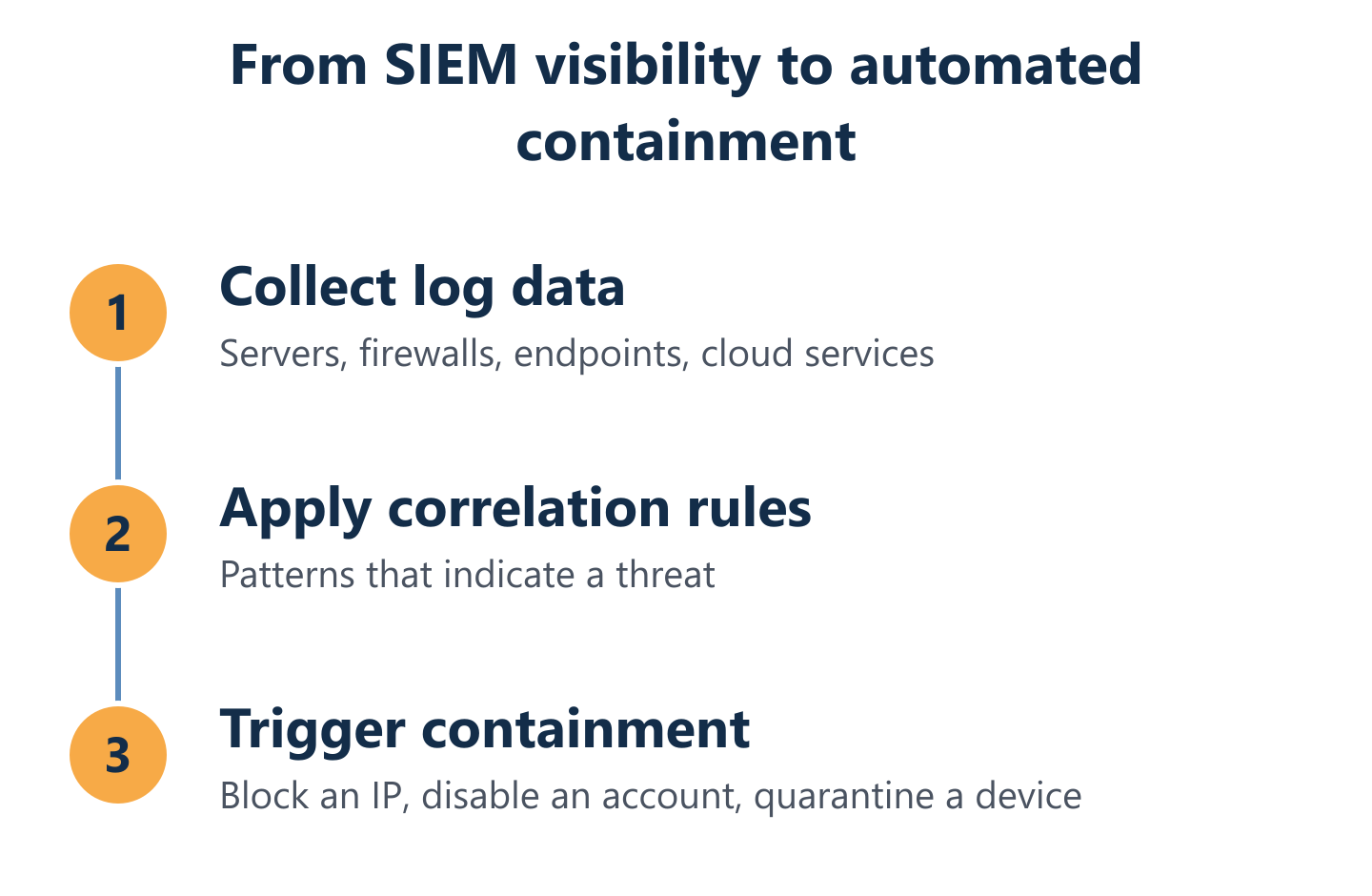
SIEM monitoring aggregates log data from across your infrastructure—servers, firewalls, endpoints, cloud services—and applies correlation rules to identify patterns that indicate a threat. Without SIEM, security teams are working from isolated data sources, making it difficult to detect multi-stage attacks that move laterally across systems. When SIEM is combined with automated response capabilities, detection events can trigger immediate containment actions—blocking an IP, disabling a compromised account, or quarantining a device—without waiting for human intervention. This is where visibility becomes action rather than just reporting. For organisations already running internal monitoring tools, a SIEM-as-a-Service layer adds the correlation and analysis depth that point solutions cannot provide alone. Our article on network security and infrastructure protection explains how these controls integrate at the infrastructure level.
Penetration testing, GDPR support, and security awareness training
Governance and readiness services reduce legal and operational risk by addressing the human and procedural dimensions of security—not just the technical. Penetration testing validates whether your technical controls actually hold under attack conditions; many organisations discover that correctly configured firewalls and patched systems still have exploitable paths through misconfigured applications or weak credentials. GDPR compliance support ensures that data handling practices, breach notification procedures, and data subject rights are properly documented and enforceable—reducing regulatory exposure in the event of an incident. Security awareness training addresses the most consistently exploited attack vector: people. Phishing simulations, policy training, and role-specific education measurably reduce the likelihood of credential compromise and social engineering success. These services are most effective when delivered as part of a continuous programme rather than a one-off exercise, and when findings feed directly back into technical control improvements. For a broader view of the regulatory and technical landscape, our overview of cybersecurity trends for businesses provides useful context.

How to choose the right provider (checklist for SOC/MDR/SIEM/IR)
Mismatched expectations between buyers and providers are the most common source of dissatisfaction in cybersecurity engagements. A provider may offer SOC-as-a-Service that covers only cloud workloads, leaving on-premise infrastructure unmonitored. An MDR contract may include response actions for endpoints but exclude network-level containment. An incident response retainer may specify a 48-hour engagement start rather than same-day mobilisation. These gaps are not always visible in proposals—they emerge during incidents, when it is too late to renegotiate scope.
The checklist below helps buyers evaluate providers on the criteria that matter most before signing:
- Scope definition: Does the service cover your full environment—cloud, on-premise, endpoints, network, and identity—or only specific layers?
- Coverage model: Is monitoring continuous, and what happens outside standard business hours if an alert is triggered?
- Response inclusions: Does the provider take active response actions (MDR), or deliver alerts only (monitoring)?
- SLA commitments: Are response and resolution times contractually guaranteed, with defined escalation paths?
- Reporting cadence: How frequently are security reports delivered, and what evidence is included?
- Onboarding timeline: How long does it take from contract signature to active monitoring?
- Pricing model: Is pricing fixed monthly or variable? Are there costs for additional assets, incidents, or out-of-scope requests?
- Compliance alignment: Does the provider support GDPR compliance requirements, and can they provide documentation for audits?
- Technology partnerships: Are they certified with the vendors whose technology they deploy (e.g., Sophos, Fortinet, Veeam)?
- Language and communication: Is support available in your preferred language, with clear escalation contacts?
Language and service windows are documented in the accepted scope, with a multidisciplinary team covering security, infrastructure, and cloud operations.
Managed Security Services vs SOC-as-a-Service vs MDR: decision criteria
These three service models are frequently confused in provider proposals, but they serve different operational needs. Managed Security Services (MSS) is the broadest category: it covers the ongoing management of security tools—firewalls, endpoint protection, patch management, and backup—without necessarily including active threat monitoring or response. SOC-as-a-Service adds continuous monitoring and alert triage, typically covering a defined set of log sources and environments. Managed Detection and Response (MDR) is the most operationally intensive: it combines detection with active response actions taken on your behalf. The decision criterion is straightforward—if your team can act on alerts, SOC-as-a-Service may be sufficient. If you lack internal capacity to respond to incidents, MDR is the appropriate model. If your primary need is reliable security tool management and infrastructure protection, Managed Security Services provides the foundation. Many organisations benefit from a combination: MSS for operational continuity, with MDR for high-risk environments or critical assets.
Typical engagement models and onboarding expectations
A well-structured cybersecurity engagement follows a predictable sequence regardless of service type. The first phase is discovery: the provider assesses your current environment, identifies assets in scope, and documents existing controls and gaps. This typically takes one to three weeks depending on infrastructure complexity. The second phase is deployment: monitoring agents, log connectors, or security tools are configured and tested. For SIEM-based services, this includes tuning correlation rules to reduce false positives. The third phase is active service delivery, with monitoring, reporting, and escalation workflows operating as agreed. Buyers should ask for a written onboarding timeline before signing, including milestones and acceptance criteria. Providers who cannot specify an onboarding plan are unlikely to deliver a structured service once the contract is active. For context on how infrastructure assessments feed into security planning, our guide on security IT audit scope, testing, and reporting outlines the discovery process in detail.
Questions to ask before signing: SLAs, automation, and incident response inclusions
Before committing to a cybersecurity services contract in Madrid, ask these questions directly and request written answers:
First, what are the contractual SLA commitments for alert response, incident escalation, and resolution—and what remedies apply if they are not met? Second, does the contract include automated response capabilities, and if so, which actions can be taken without prior authorisation? Third, is incident response included within the monthly fee, or is it billed separately as a retainer or time-and-materials engagement? Fourth, how is scope change handled—if you add cloud workloads, new endpoints, or additional sites, does the price change automatically? Fifth, what compliance documentation is provided to support GDPR audits or regulatory reviews? Providers who answer these questions clearly, with contractual backing, demonstrate the governance rigour that separates reliable partners from those who perform well only in pre-sales conversations.
Selecting cybersecurity services in Madrid based on scope, coverage model, and documented response capability—rather than provider lists or brand recognition—is the most reliable way to reduce operational risk. The organisations that experience the fewest disruptions are those that treat security as an integrated part of IT operations, with clear SLAs, tested continuity plans, and a single accountable partner. If you are evaluating providers or reviewing your current security posture, Impulso Tecnológico offers a practical starting point: over 26 years of managed IT and security experience, flexible contracts, and a multidisciplinary team with remote support and on-site work confirmed per request.