Cybersecurity services for companies in Valencia can cover threat monitoring, incident response, endpoint protection, network hardening and backup continuity, with response targets and pricing documented in the managed-service proposal.
Valencia's business environment spans manufacturing, logistics, agri-food and professional services — sectors where a single security incident can halt production lines, delay port shipments or expose sensitive client data. The challenge is not simply deploying security tools; it is ensuring those tools are monitored, maintained and backed by a team that can respond before a minor alert becomes a critical breach. The result: predictable costs, reduced downtime risk and an IT environment that actively supports business growth rather than constraining it.
What cybersecurity services companies in Valencia actually need
Not every Valencia company faces the same threat landscape. A 20-person professional services firm has fundamentally different exposure than a 300-employee manufacturer with OT systems on the factory floor. Matching security scope to operational reality — rather than applying a generic package — is the starting point for any credible managed security services provider.
Impulso Tecnológico approaches this by treating cybersecurity as an operational service, not a one-off project. That means combining remote assistance, request-confirmed site work and commercial terms defined for the accepted scope. The goal is to give Valencia businesses continuous expert attention without the overhead of managing multiple vendors.
| Company profile | Primary risk areas | Core services required | Key delivery expectation |
|---|---|---|---|
| SME (up to 50 users) | Phishing, ransomware, credential theft | Endpoint protection, email security, backup | Fixed monthly cost, rapid remote response |
| Mid-market (50–250 users) | Lateral movement, insider threats, compliance gaps | Network segmentation, vulnerability management, SOC monitoring | SLA targets, regular reporting and site work defined in the accepted scope |
| Multi-site / industrial | OT/IT convergence, supply chain attacks, downtime | Network hardening, incident response, business continuity | Single accountable provider, coordinated response across sites |
| Logistics / port operations | Operational disruption, data interception, access control | Perimeter security, access management, encrypted communications | Minimal downtime, fast containment, GDPR alignment |
Security needs by business reality: SMEs, mid-market and multi-site operations
Security scope must align with what a business is actually trying to protect: uptime, productivity, client data and predictable costs. For SMEs, the priority is typically preventing ransomware and phishing from causing operational paralysis — basic but properly configured endpoint protection, email filtering and tested backups deliver measurable risk reduction. Mid-market companies add complexity: they need network segmentation to limit lateral movement, vulnerability management to close known gaps, and structured reporting to demonstrate security posture to stakeholders. Multi-site operations — common in Valencia's manufacturing and logistics sectors — require coordinated management across locations, consistent policy enforcement and a provider capable of responding on-site when remote resolution is insufficient. Across all profiles, the common thread is predictability: fixed costs, defined response times and a provider who owns the outcome rather than deflecting responsibility.
Risk drivers in Valencia industries: manufacturing, logistics/port, education and professional services
Valencia's industrial base creates specific attack surfaces that generic cybersecurity frameworks do not always address. Manufacturing companies face OT/IT convergence risks — production systems increasingly connected to corporate networks create pathways that attackers exploit. Logistics and port operations depend on uninterrupted data flows; a ransomware event that locks booking or tracking systems can cascade into significant financial and reputational damage within hours. Education institutions hold large volumes of personal data and typically operate with limited IT budgets, making them attractive targets for credential harvesting. Professional services firms — law, accounting, consultancy — carry sensitive client information and face regulatory obligations under GDPR. Across all these sectors, the full attack path runs through email, endpoints, network infrastructure, identity management and backup systems: every layer must be addressed, not just the most visible one.
Service delivery expectations: remote support, on-site checks and transparent SLAs
A cybersecurity service is only as reliable as the commitments behind it. Valencia companies should expect measurable delivery: documented SLAs that specify response and resolution times, clear escalation paths and regular reporting that shows what was detected, what was resolved and what remains open. Remote support — delivered over encrypted connections — handles the majority of incidents efficiently and minimises operational disruption. On-site intervention is essential for hardware checks, compliance verification, physical access control reviews and critical infrastructure tasks where remote access is insufficient or inappropriate. Impulso Tecnológico combines both modalities, with a multidisciplinary team that manages thousands of support interactions annually across clients in Spain and internationally. The reporting cadence — monthly summaries, incident reports and proactive recommendations — gives decision-makers the visibility they need to manage risk without becoming IT specialists themselves.
Core managed services: SOC, threat detection, incident response and vulnerability management
Managed security services are not a single product — they are a structured set of capabilities that work together to detect, contain and recover from threats. Understanding what each component delivers, and what "good" looks like in practice, is essential before committing to any provider. Impulso Tecnológico's proactive, security-first model integrates advanced monitoring for early intervention with rapid, multidisciplinary response and practical remediation through trusted technology partners including Sophos, Fortinet and Veeam.
- Continuous monitoring: System performance and security telemetry are tracked continuously, enabling proactive intervention before minor anomalies escalate into confirmed incidents.
- Alert triage and prioritisation: Alerts are assessed by severity and context — not every alert requires the same urgency — so response resources are directed where they matter most.
- Threat detection and correlation: Events from endpoints, network devices and identity systems are correlated to identify attack patterns that individual alerts would not reveal in isolation.
- Incident response activation: When a confirmed threat is identified, a structured response workflow begins: assess scope, contain the threat, eradicate the root cause and restore normal operations.
- Vulnerability scanning and remediation: Regular analysis identifies known weaknesses across systems; findings are prioritised by risk and remediated with guidance, not just flagged in a report.
- Reporting and continuous improvement: Post-incident reviews and periodic security reports feed back into updated controls, closing gaps and improving resilience over time.
SOC monitoring and threat detection: what is monitored, how alerts are handled and how reporting works
Effective SOC monitoring centralises telemetry from across the environment — endpoints, firewalls, email gateways, identity platforms and network devices — into a coherent picture of security status. The value is not in generating more alerts; it is in prioritising them accurately so that genuine threats receive immediate attention while low-risk noise is filtered. Impulso Tecnológico uses advanced monitoring platforms to track system performance and security indicators continuously, enabling early identification of anomalies before they become confirmed incidents. Alerts are triaged by severity and context: a failed login from a known internal IP carries different weight than a credential attempt from an unfamiliar geography. Reporting translates technical findings into business-relevant summaries — what was detected, how it was handled and what the current risk posture looks like — giving management the information needed to make informed decisions without requiring deep technical expertise.
Incident response workflow: assess, contain, monitor again, recover and document lessons learned
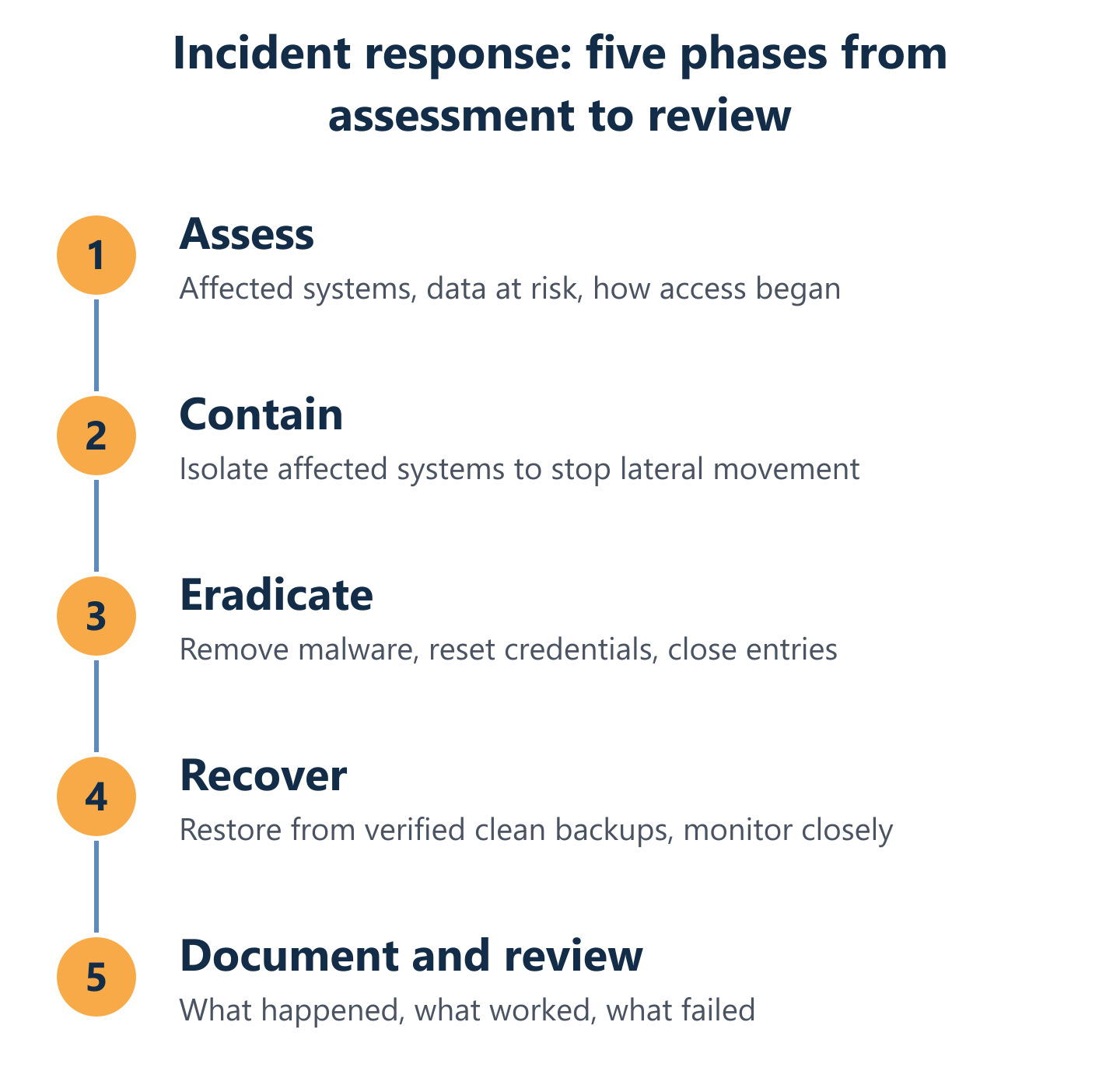
When a security incident is confirmed, the speed and structure of the response directly determines how much damage is done. A well-defined incident response workflow moves through five phases without improvisation. Assessment establishes the scope: which systems are affected, what data is at risk and how the attacker gained access. Containment isolates affected systems to prevent lateral movement — network segmentation and access control policies are critical enablers here. Eradication removes the threat: malware is eliminated, compromised credentials are reset and vulnerable entry points are closed. Recovery restores systems to normal operation from verified clean backups, with monitoring intensified to confirm the threat is gone. Documentation and post-incident review complete the cycle: what happened, what worked, what failed and what controls need strengthening. This structured approach — rather than ad hoc firefighting — is what separates a managed security incident response capability from reactive break-fix support.
Vulnerability management: analysis, prioritisation, remediation guidance and verification
Vulnerability scanning alone is not vulnerability management. A scan produces a list; management turns that list into closed risks. The process begins with analysis: identifying known weaknesses across operating systems, applications, firmware and network devices using up-to-date threat intelligence. Prioritisation follows — not every vulnerability carries the same urgency. A critical flaw in an internet-facing system with no compensating controls ranks far above a medium-severity issue on an isolated internal workstation. Remediation guidance translates findings into actionable steps: patching schedules, configuration changes, compensating controls where patching is not immediately possible. Verification confirms that remediation was effective — a step many providers skip. Impulso Tecnológico integrates vulnerability management into its broader managed services model, meaning findings feed directly into maintenance cycles rather than sitting in a report waiting for someone to act. For a deeper look at how this connects to network-level risk, our article on computer network audits for security and optimisation covers the audit methodology in detail.

Preventive controls, business continuity and how to choose a provider in Valencia
Prevention reduces the probability of an incident; continuity planning reduces the impact when one occurs despite preventive controls. Both are necessary — neither is sufficient alone. Impulso Tecnológico's differentiation rests on combining enterprise-grade security foundations with clear SLAs, transparent fixed monthly pricing and a single accountable provider that coordinates both prevention and recovery.
The technology stack underpinning this approach includes:
- Sophos and Fortinet for endpoint protection, firewall management and network security — covering perimeter defence and internal threat detection.
- Veeam for backup and disaster recovery — ensuring data is protected, recoverable and tested against realistic recovery scenarios.
- Microsoft 365 and Azure for cloud identity, email security, collaboration and licence management — reducing exposure from credential-based attacks.
- Cisco and Aruba for network infrastructure where segmentation, access control and wireless security require enterprise-grade hardware.
- Per-device packages with remote and on-site coverage defined in the accepted scope — eliminating the budget uncertainty that makes security investment decisions difficult for Valencia businesses.
- Defined SLA targets with documented measurement and escalation paths in the accepted scope.
Layered security controls: email protection, endpoint hardening, network segmentation and access control
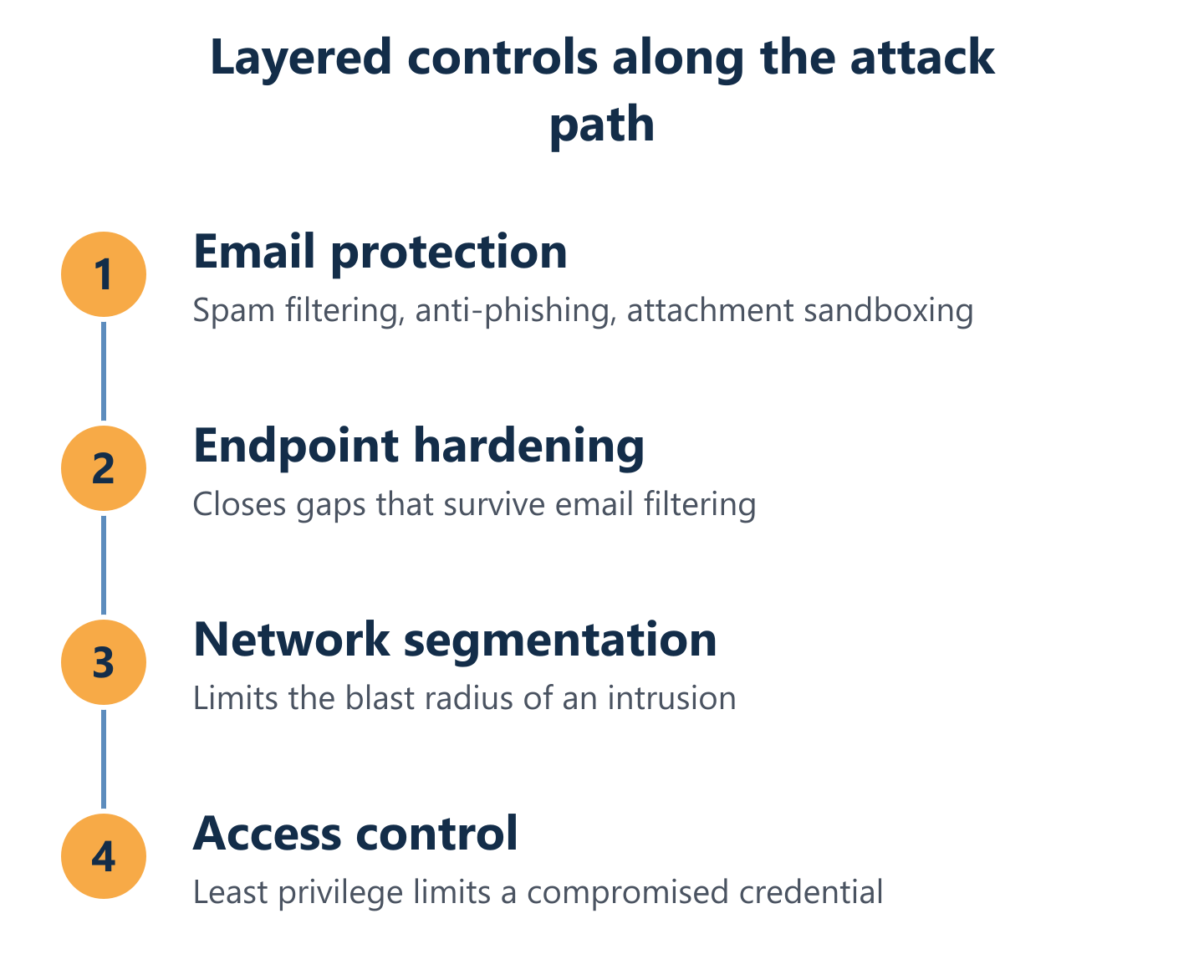
Phishing remains the most common entry point for ransomware and business email compromise. Email security controls — spam filtering, anti-phishing policies, DMARC/DKIM/SPF configuration and attachment sandboxing — reduce the volume of malicious content that reaches users. Endpoint hardening closes the gaps that survive email filtering: application whitelisting, patch management, local firewall policies and behavioural detection through tools such as Sophos Intercept X prevent malware from executing even when a user clicks something they should not. Network segmentation limits the blast radius of a successful intrusion — if an attacker compromises one segment, they cannot move freely to production systems, financial data or backups. Access control policies enforce least-privilege principles: users and systems access only what they need, reducing the value of any single compromised credential. Together, these layers address the full attack path rather than relying on any single control to carry the entire defensive burden. For more detail on network-level protection strategies, our guide to comprehensive network security for businesses provides a thorough technical overview.
Business continuity: backup strategy, recovery readiness and agile incident response to reduce downtime
A backup that has never been tested is not a backup — it is an assumption. Business continuity planning requires three things: a backup strategy that covers all critical data with appropriate retention and offsite or cloud replication; regular recovery testing that validates restore times against realistic recovery point and recovery time objectives; and an incident response capability that can activate containment and recovery procedures quickly when an event occurs. Impulso Tecnológico implements backup and disaster recovery using Veeam, which supports granular recovery, immutable backup copies and integration with cloud storage to protect against ransomware that targets on-premises backup repositories. The agile response model — assess, contain, recover — is designed to minimise the window between incident detection and restored operations, reducing both direct costs and the reputational impact of prolonged downtime. For Valencia companies in sectors where every hour of downtime carries measurable financial consequences, this structured approach to continuity is not optional.
Provider selection checklist: questions to ask, pros/cons to compare and trust signals to request
Choosing a cybersecurity provider in Valencia requires moving beyond marketing claims to verifiable commitments. Use this checklist when evaluating candidates:
- SLA clarity: Are response and resolution times documented by incident severity? What happens if SLAs are missed?
- Scope definition: Does the contract specify exactly what is monitored, what is included in incident response and what triggers an on-site visit?
- Industry fit: Has the provider worked with companies in your sector? Can they demonstrate familiarity with your specific risk profile (e.g., OT systems, GDPR obligations, logistics operations)?
- Technology transparency: Which vendor technologies are used and why? Are they certified partners of those vendors?
- Proof of delivery: Can they provide anonymised case references, sample reports or evidence of incident response outcomes?
- Pricing model: Is pricing fixed and per-device, or variable and difficult to forecast? Are there hidden costs for on-site visits or out-of-scope incidents?
- Single accountability: Is there one point of contact who owns the outcome, or will you be coordinating between multiple sub-contractors?
For a broader view of what to look for in a security assessment before engaging a provider, our overview of IT security plan implementation offers a structured starting point.
When cybersecurity is delivered as a managed, SLA-backed service, Valencia companies gain something more valuable than a collection of security tools: they gain a stable operational foundation. Predictable monthly costs replace unpredictable incident expenses. Proactive monitoring replaces reactive firefighting. A single accountable provider replaces fragmented multi-vendor complexity. Impulso Tecnológico has built this model over more than 26 years, combining technical experience with technology selected for each accepted scope. If your organisation is ready to move from ad hoc security to a structured, measurable managed service, the next step is a straightforward conversation about your current environment and objectives.