Structured cabling installation is the process of deploying a standardised, hierarchical wiring infrastructure that supports voice, data, and fibre optic communications across a building or campus. Unlike ad hoc point-to-point wiring, a structured system is planned, documented, and tested to meet recognised industry standards—making it scalable, easier to manage, and far less prone to costly downtime.
Many organisations only discover the limitations of their existing cabling when it starts affecting performance: bandwidth bottlenecks, unexplained connectivity drops, or technicians spending hours tracing unlabelled cables during a fault. These are not equipment failures—they are infrastructure failures. A properly designed structured cabling system eliminates these constraints by creating a physical layer that can carry telephone, Ethernet, and security traffic over a unified, organised architecture. For related planning criteria, see Computer network installation.
What Structured Cabling Installation Means (and what you get)
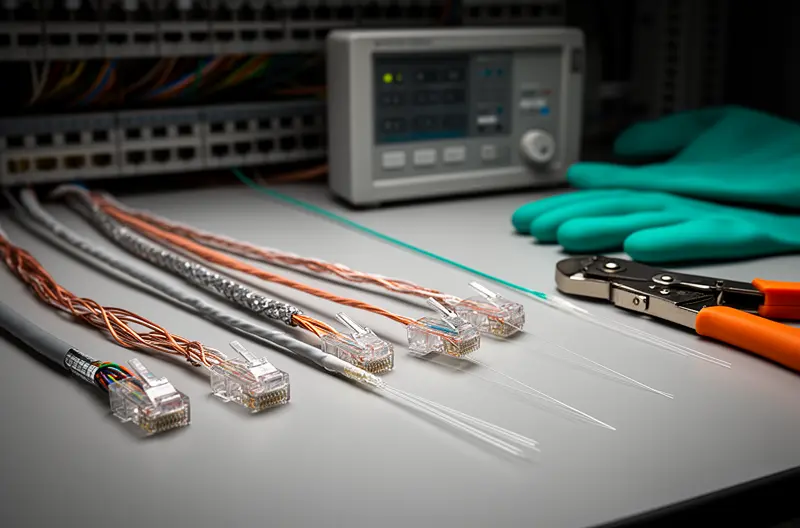
Structured cabling installation is not simply the act of running cables between devices. It is the deployment of a complete, standards-compliant physical network infrastructure—one that is designed with a defined hierarchy, documented from day one, and built to accommodate growth without requiring wholesale replacement. The scope of a typical project covers everything from the entrance facility where external services enter the building, through telecommunications rooms and equipment rooms, all the way to individual work area outlets. Components include twisted-pair copper cable (Cat5e, Cat6, Cat6A, or Cat7), fibre optic cabling, patch panels, cable trays, and management systems that keep every run organised and identifiable.
At Impulso Tecnológico, we treat structured cabling as a complete infrastructure project rather than a cabling task. The result is a system your IT team can operate confidently and expand without surprises.
| Criterion | Point-to-Point Cabling | Structured Cabling System |
|---|---|---|
| Scalability | Each new device requires a dedicated run; grows chaotic quickly | Modular design allows ports and runs to be added without rework |
| Troubleshooting speed | Tracing unlabelled cables is time-consuming and error-prone | Labelled ports and documented routes enable rapid fault isolation |
| Standards compliance | Rarely tested or certified; performance unverified | Tested against ANSI/TIA-568, EN 50173, or ISO/IEC 11801 as applicable |
| Support for multiple applications | Separate runs for voice, data, and security are common | Unified physical layer carries voice, Ethernet, and fibre traffic |
| Long-term cost | Higher: repeated interventions, abandoned cabling, downtime | Lower: planned infrastructure reduces reactive spend |
Definition and difference versus point-to-point cabling
Point-to-point cabling connects each device directly to another with a dedicated cable, which works for very small environments but becomes unmanageable as soon as the network grows. Structured cabling replaces this approach with a planned hierarchy: cables run from work area outlets to telecommunications rooms, which connect via backbone cabling to equipment rooms and the entrance facility. This hierarchy means that adding a workstation, relocating a team, or upgrading a floor does not require rewiring the building—it requires a patch cord change and a documentation update. The result is a network that stays organised, performs consistently, and supports troubleshooting without guesswork. Recognised standards such as ANSI/TIA-568 and ISO/IEC 11801 define the architecture precisely, ensuring interoperability regardless of the hardware vendor.
System architecture overview: entrance, rooms, horizontal, and backbone
A structured cabling system is divided into six subsystems, each with a specific function. The entrance facility is where external telecommunications services—including ISP connections and wide-area links—enter the building and connect to the internal infrastructure. Equipment rooms house centralised hardware such as servers, core switches, and patch panels. Telecommunications rooms (also called floor distributors) serve individual floors or zones, connecting horizontal cabling from work area outlets back to the backbone. Horizontal cabling spans from these rooms to each outlet, typically using Cat6 or Cat6A copper for distances up to 90 metres. Backbone cabling (vertical cabling) interconnects equipment rooms and telecommunications rooms across floors or buildings, often using fibre optic cabling for high-bandwidth, long-distance runs. Work area components—outlets, faceplates, and patch cords—complete the connection at the user end.
Key deliverables: routes, patching, labelling, and certification
The deliverables from a structured cabling installation project go well beyond the physical cables in the wall. A complete project should produce: installed and terminated cable runs from outlets to patch panels, with each port correctly punched down and tested; a labelling scheme applied consistently to every port, panel, and outlet so that any technician can identify a connection without prior knowledge of the site; as-built documentation recording cable routes, termination points, and port assignments; and certification test results demonstrating that each link meets the performance specification for its category. At Impulso Tecnológico, we include all of these deliverables as standard—because a cabling system without documentation is only half-finished. The unified physical layer also supports Power over Ethernet (PoE) applications, allowing IP phones, wireless access points, Verkada security cameras, and IoT devices to draw power and data over the same structured infrastructure.

Design and Installation Process: From Planning to Termination
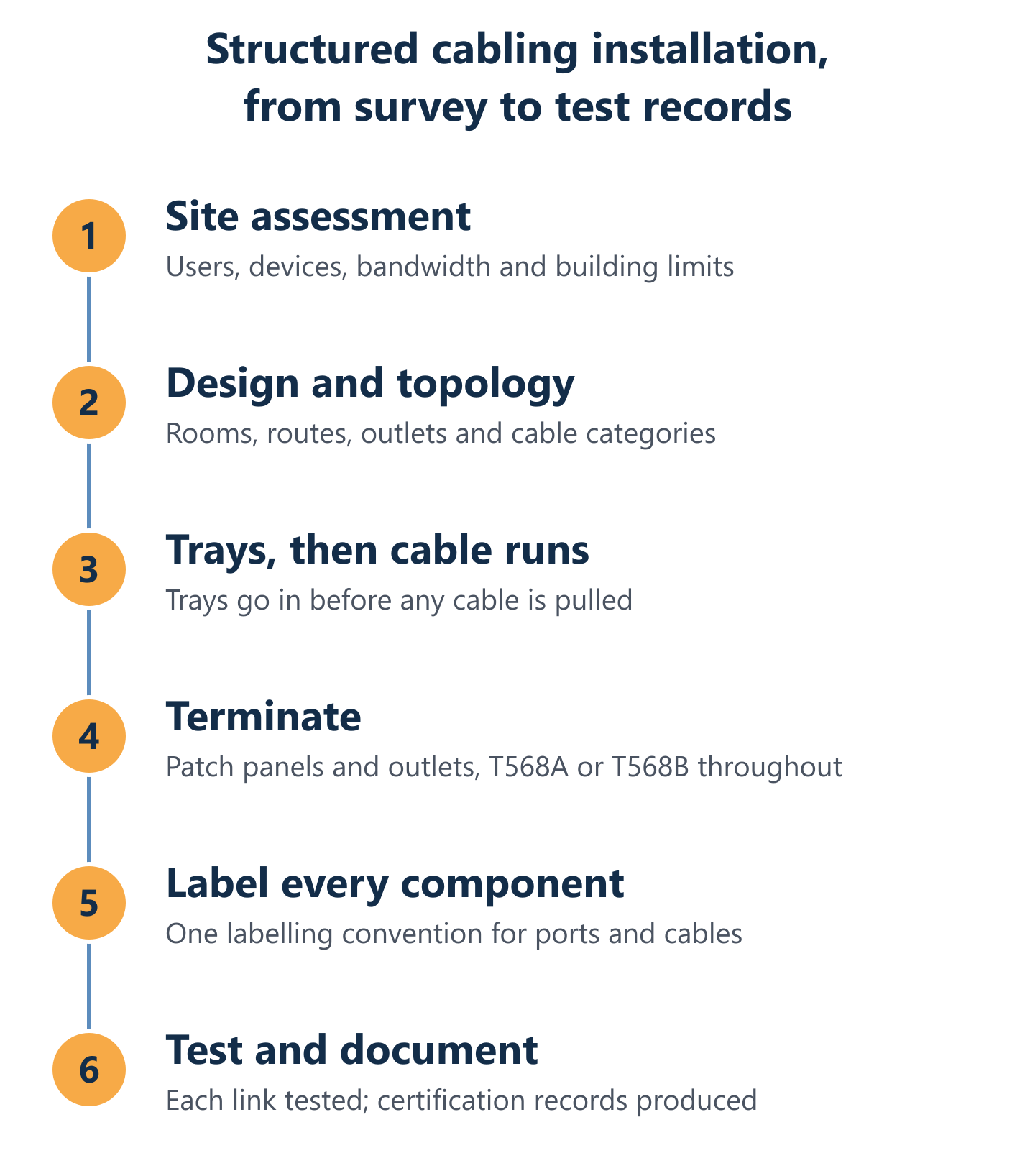
A structured cabling installation that performs well over years—not just on day one—depends on decisions made before a single cable is pulled. The practical workflow begins with understanding what the building needs to support, and it ends with verified, documented connections that your team can manage confidently. At Impulso Tecnológico, our process goes beyond running cables through walls: we assess requirements, design the optimal layout, mount cable trays and management systems, pull and terminate cables to patch panels and work area outlets, and label every component so that ongoing operations remain straightforward. We offer free on-site consultations followed by transparent, fixed-price quotations—so budget uncertainty is eliminated before work begins.
- Site assessment and requirements analysis: Evaluate the number of users, device types, bandwidth demands, and physical constraints of the building to define capacity and pathway requirements.
- Design and topology planning: Map telecommunications room locations, backbone routes, horizontal cable pathways, and work area outlet positions; select cable categories and fibre specifications to match current and projected needs.
- Cable tray and management installation: Mount trays, conduits, and management systems along planned routes before pulling any cable, ensuring organised, protected pathways throughout.
- Cable pulling and routing: Pull copper and fibre runs through designated pathways to patch panels and outlets, respecting bend radius limits and separation requirements to preserve signal integrity.
- Termination at patch panels and outlets: Punch down copper pairs to patch panel ports and terminate at wall outlets using correct wiring standards (T568A or T568B consistently throughout the installation).
- Labelling and cross-connect configuration: Apply a consistent labelling convention to every port, panel, outlet, and cable, and configure cross-connects to establish the logical connections between subsystems.
- Testing, verification, and certification documentation: Test each link against category performance specifications and produce certification records that confirm compliance and support future changes.
Planning and design for future-proof networks (capacity, layout, topology choices)
The most expensive structured cabling mistake is under-specifying at the design stage. Installing Cat5e when the organisation's growth trajectory clearly points toward higher bandwidth applications means rework within a few years—a cost that a proper upfront assessment would have avoided. Effective planning starts with a capacity audit: how many work area outlets are needed now, and how many should be provisioned for growth? Where will telecommunications rooms be located to keep horizontal runs within the 90-metre copper limit defined by ANSI/TIA-568? Does the backbone need to carry 10 Gigabit traffic between floors, which would favour multimode or single-mode fibre over copper? These decisions shape the entire installation. At Impulso Tecnológico, our site consultations address these questions directly, producing a design that matches both current requirements and a realistic view of future demand—without over-engineering unnecessarily.
Installation workflow: routing, cable management, patch panels, and work area outlets
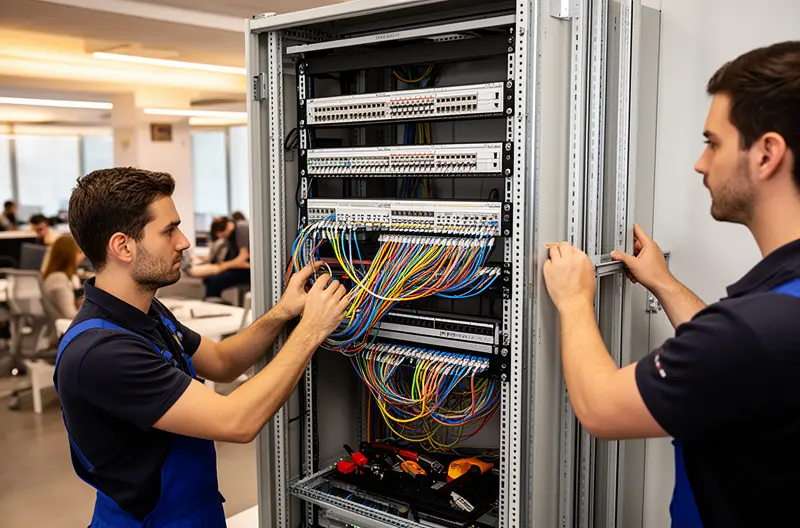
Patch panels are the operational heart of a structured cabling system. Every horizontal cable run terminates at a patch panel port in the telecommunications room, and a short patch cord then connects that port to the active equipment—switch, router, or voice gateway. This arrangement means that moving a user from one desk to another, or reassigning a port to a different VLAN, requires only a patch cord change rather than a physical cable move. Cable management panels keep patch cords organised and prevent the tangled, stress-inducing environments that make fault isolation so difficult. During installation, cable trays and conduits must be mounted before cables are pulled, and all runs must respect minimum bend radius specifications—particularly for fibre optic cabling, where tight bends cause measurable signal loss. Work area outlets should be positioned to serve current desk layouts while allowing for reasonable reconfiguration.
Labelling, cross-connects, and termination best practice for operational clarity
Correct termination and consistent labelling are where many installations fall short—and where the long-term operational cost of a poor installation becomes visible. Each copper pair must be punched down to the correct pin assignment (T568A or T568B, applied uniformly) and untwisted for the minimum distance possible at the termination point, since excessive untwisting introduces crosstalk that degrades category performance. Every port on every patch panel, every outlet faceplate, and every cable should carry a label that follows a documented convention—typically encoding the telecommunications room, panel, and port number. Cross-connects between subsystems should be recorded in the as-built documentation so that any technician can trace a connection end-to-end without physical investigation. At Impulso Tecnológico, we apply this discipline on every installation, because clear labelling and correct termination are what separate a network cabling certification that holds value from one that is merely a piece of paper.
Testing, Standards, and Ongoing Maintenance for Long-Term Reliability
Physical installation is only complete when every link has been tested and the results are documented. Testing validates that the cabling performs to the category specification it was installed to meet—and it catches termination errors, damaged cables, and wiring faults before they become operational problems. The recognised standards that govern structured cabling performance—ANSI/TIA-568 in North America, EN 50173 in Europe, and ISO/IEC 11801 internationally—define the electrical and optical parameters that each link must meet. Compliance with these standards is not bureaucratic box-ticking; it is the mechanism that ensures your cabling will support the active equipment connected to it, now and when you upgrade.
At Impulso Tecnológico, we perform rigorous post-installation testing and provide certification documentation as a standard deliverable. Our installations also support modern PoE requirements, which means the same structured cabling foundation can power and connect IP phones, wireless access points, Verkada security cameras, and IoT devices—reducing the complexity and cost of separate power infrastructure.
- What testing covers: Wiremap (correct pin assignment), length, insertion loss, return loss, near-end crosstalk (NEXT), and propagation delay—parameters defined by ANSI/TIA-568, EN 50173, and ISO/IEC 11801 for each cable category.
- Why certification matters: A certified link gives you a manufacturer-backed performance guarantee and confirms that the installation meets the specification for Cat5e, Cat6, Cat6A, Cat7, or the relevant fibre standard.
- Documentation as a living record: As-built records, port maps, and test results should be updated whenever moves, adds, or changes occur—not just at project completion.
- Maintenance practices that extend infrastructure life: Scheduled testing, removal of abandoned cabling, and documentation updates keep the system aligned with how the network actually operates.
- PoE considerations: Higher-power PoE applications (IEEE 802.3bt, up to 90W) generate heat in bundled cables; correct cable category selection and installation practice are essential to maintain performance under load.
Testing and verification against recognised standards (ANSI/TIA-568, EN 50173, ISO/IEC 11801)
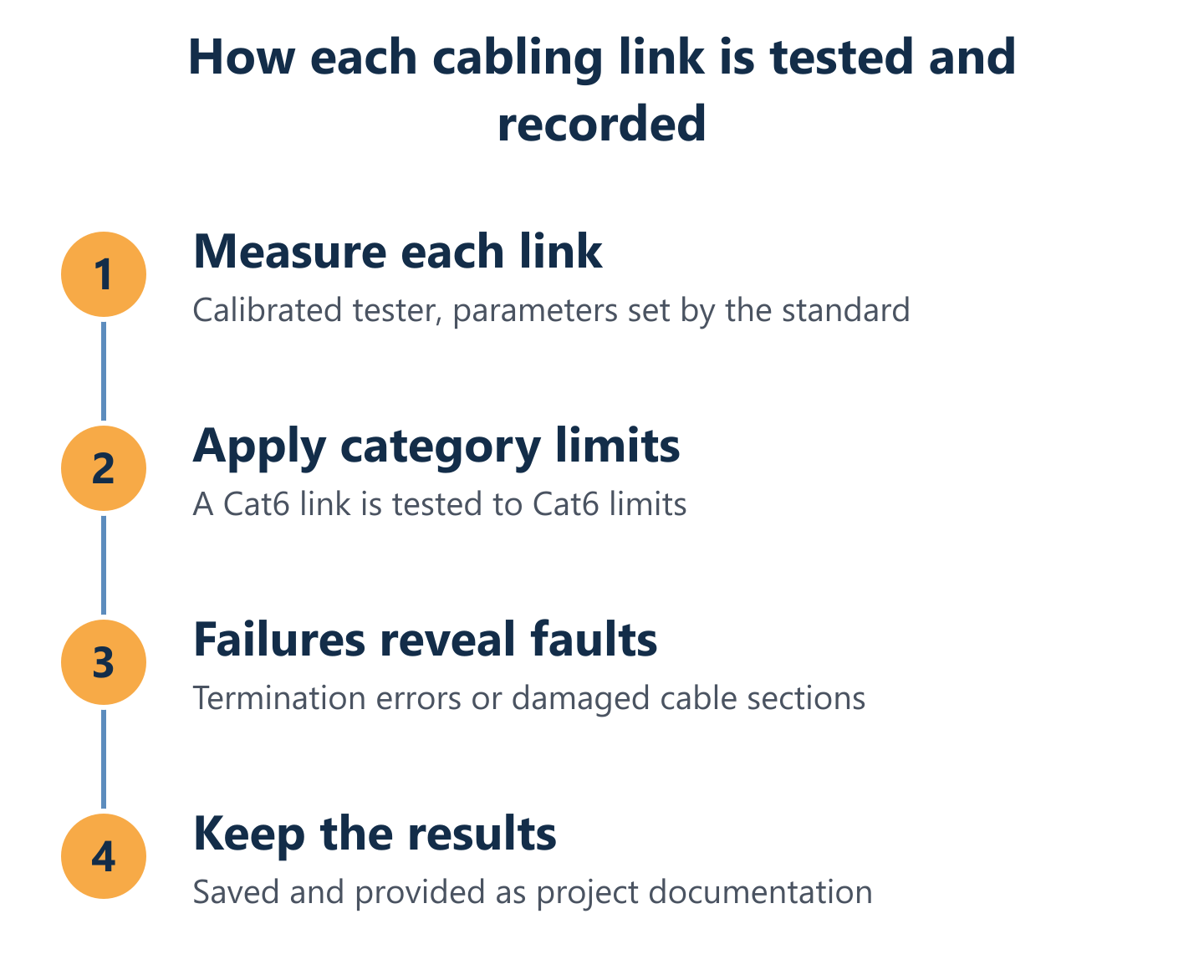
Certification testing is not optional if you want a cabling installation that performs reliably over its intended lifespan. Using a calibrated field tester, each installed link is measured against the performance parameters defined by the applicable standard: ANSI/TIA-568 for North American projects, EN 50173 for European installations, and ISO/IEC 11801 as the international framework that underpins both. These standards specify limits for insertion loss, crosstalk, and return loss at frequencies relevant to the cable category—so a Cat6 link is tested to Cat6 limits, and a Cat6A link to Cat6A limits. Failures at this stage reveal termination errors or damaged cable sections that would otherwise cause intermittent faults in live operation. The test results are saved and provided as part of the project documentation, giving the client verifiable evidence of compliance and a baseline for future comparison.
Documentation that matters: as-built records, port mapping, and labelling conventions
The value of documentation becomes apparent the first time a fault needs to be isolated quickly, or when a new team member needs to add a workstation without calling in a specialist. As-built records should capture the physical route of every cable run, the patch panel and port where it terminates, the outlet it serves, and the test result that certified its performance. Port mapping—a clear table linking each patch panel port to its corresponding outlet and active equipment connection—is the operational tool that makes moves, adds, and changes manageable. Labelling conventions documented in writing ensure that the scheme remains consistent even when different engineers work on the system over time. At Impulso Tecnológico, we provide all of this as a standard project deliverable, because documentation is what transforms a cabling installation into a manageable, long-lived infrastructure asset rather than an opaque tangle of cables.
Common use cases and trade-offs: office builds, relocations, and low-voltage applications
Structured cabling is the right choice for any environment where connectivity needs to be reliable, organised, and capable of evolving. New office builds are the clearest case: installing structured cabling during construction or fit-out is significantly less disruptive and less costly than retrofitting later. Office relocations benefit from a structured approach because the new site can be cabled to a consistent standard before staff arrive, avoiding the productivity loss of a chaotic move. Low-voltage applications—IP telephony, wireless access points, access control, and IP security cameras—are increasingly delivered over the same structured cabling infrastructure that carries data, using PoE to eliminate separate power runs. The trade-off to consider is upfront investment versus long-term operational cost: structured cabling costs more than ad hoc wiring initially, but the reduction in troubleshooting time, downtime, and repeated interventions makes it the lower-cost option over any realistic planning horizon.
When structured cabling is designed, installed, and certified as a system, connectivity becomes dependable, scalable, and easier to manage as your business changes. The difference between a network that holds up under growth and one that becomes a recurring operational problem is almost always traceable to the physical layer—how it was planned, how it was installed, and whether it was tested and documented properly. If you are evaluating a new installation, a site relocation, or an upgrade to an existing network, the starting point is a clear picture of your current infrastructure and future requirements. Impulso Tecnológico offers free on-site consultations and fixed-price quotations to give you exactly that—without obligation and without ambiguity.